Why Barcelona Is Tired of Visitors, and How Not to Be the Reason
LineCast Networks
Barcelona once had one of its own bus routes taken off Google Maps.
Route 116 is a neighbourhood shuttle, a stubby little vehicle that climbs from Gràcia to the upper gate of Park Güell. People living in La Salut ran a signature campaign because they could no longer board it. Every seat and every handhold belonged to somebody going to photograph a mosaic lizard. The petition asked for more frequency on the line, or failing that for some arrangement that handed the bus back to the neighbourhood. The council went through the second door. It had the 116 stripped out of the mapping apps and the search results that had been recommending it as the clever way up the hill. The route did not change. The timetable did not change. It simply stopped being suggested to anyone who did not already know it was there, and the residents got their bus back.
Hold onto that, because the shouting version of this story gets it wrong. Barcelona has not banned visitors from anything. What it has done, over and over and in writing, is quietly withdraw convenience from the exact points where visitor demand had crushed ordinary use. Which means the useful skill for a guest here is not guilt. It is reading what the city has already published about itself.
The shape of the problem
The council's own tourism strategy for 2024 to 2027 estimates 170,000 tourists in Barcelona on an average day. They are not evenly spread. Ciutat Vella, the old town, carries a daily density of 14,177 tourists per square kilometre. The Eixample, immediately uphill, carries 6,551. Of the eight remaining districts, half sit in the low hundreds, but two still carry more than two thousand each. The same document identifies fifteen "espais de gran afluència", high-attendance spaces, a roster the council has since taken to sixteen, and it picks out the Boqueria market as a fragile place never built to absorb what arrives at it.
The city also asks its residents what they think, every year, in a formal survey run by its statistics office. The results are blunt. Around three quarters of those interviewed say Barcelona has reached, or is reaching, the limit of its capacity to receive tourists, and that includes roughly two thirds of the people who work in tourism. Nearly six in ten said they had given up on visiting some part of their own city because of the crowds, a figure that has risen at every edition. In the neighbourhoods officially classed as tourist neighbourhoods, more than half say tourism damages them personally, not abstractly.
Now the part that complicates the placards. In the separate municipal barometer, which asks residents to name the single most serious problem facing the city, housing comes first by a distance, public safety second, and tourism has drifted down the list. Barcelonins do not describe tourism as the wound. They describe housing as the wound, and street behaviour as the daily aggravation, and they hold tourism responsible for both. Close to nine in ten support tougher penalties for antisocial conduct.
That distinction matters, because it tells you which of your choices actually register.

Where you sleep is the loudest thing about you
The council's plan is that by November 2028 Barcelona has no licensed tourist flats at all. It has taken up a Catalan decree that lets municipalities decide the question and has said it will apply it without exceptions: the roughly 10,000 existing licences run out on 24 November 2028 and are not renewed, and the city's planning framework for tourist accommodation will contain no category under which a new one could be issued. Those flats return to the rental and sale market.
That plan is not a consultation, and so far it has survived every court it has been taken to. The Constitutional Court has upheld the Catalan decree the whole thing rests on. The Catalan high court has dismissed the flat owners' challenges to Barcelona's own planning framework. One thread is still loose: the owners' association has asked that same Catalan court to refer the decree up to the EU Court of Justice, arguing that wiping out a licence class wholesale fails the proportionality test in European services law, and the association expects a decision on whether to refer around the turn of 2027. So the date is settled in Spanish law and still arguable in European law, which is a long way from being a proposal.
Until then, a licensed flat remains legal, and an unlicensed one remains the thing your downstairs neighbour reports. The council receives an average of about 300 complaints a month about illegal tourist-letting activity. Its civic agents log the highest concentration of tourist-flat incidents around the Sagrada Família, along Avinguda del Paral·lel through Poble Sec and Sant Antoni, and near the Rocafort metro station, all of them areas with above-average resident population density. Those are ordinary blocks of flats where people get up for work.
The practical version: a hotel or a hostel is a building designed for people arriving at odd hours with wheeled luggage. A flat in a residential stairwell is not. If you do book a flat, the licence number is the whole question, and the three concentrations named above tell you which addresses are already sore.
Noise is the grievance with teeth
Barcelona rewrote its coexistence bye-law, the ordinance that governs what you may and may not do in public space, for the first time in twenty years. The revision widened the list of punishable conduct and raised several ceilings.
Read the schedule and you can see precisely what the city is aiming at. Organising or promoting pub crawls is now sanctionable up to 3,000 euros, a category that did not previously exist. Breaking residents' rest by singing, shouting or brawling carries the same ceiling. Drinking alcohol where minors are present, or in areas under night-time noise restrictions, is its own offence. Urinating in a narrow street or a nightlife area, where public toilets exist nearby, is treated more severely than urinating generally. In one recent year the Guàrdia Urbana filed more than 38,000 reports for drinking in public space and more than 7,000 for noise.
Ciutat Vella goes further. The district has banned organised drinking routes between licensed venues since 2012, between eleven at night and seven in the morning, and has extended the prohibition through 2028. The fines attach not only to the participants' guide but to the promoting company and to the collaborating bars, which is why the offer has become harder to find online: the council has been working with the listings platforms to pull the adverts.
The behaviour being described is not exotic. It is twelve people saying goodbye at volume in a stone canyon at two in the morning, under windows that are open because it is August and there is no air conditioning. Nobody minds you being out. They mind the stairwell.
Guided groups, and why the Gothic Quarter feels like that
Since 2023, a guided group in Ciutat Vella may not exceed twenty people, and guides may not use loudspeakers, the intention being to push the trade towards radioguides and earpieces. The decree also caps how many groups may occupy a given space at once, across twelve named places: eight in Plaça de Sant Jaume and eight in Plaça Reial, five in Plaça del Rei, three each at the façade of Santa Maria del Mar, the Fossar de les Moreres, Passeig del Born and Plaça del Pi, two each in Plaça de Sant Felip Neri, Plaça d'Isidre Nonell and Carrer de Salomó Ben Adret, and one apiece in Plaça de la Barceloneta and in front of the Palau de la Música. Where a stop requires an on-site explanation, the text says the explanation must be brief on busy days. Civic agents patrol in pairs to check, and the Guàrdia Urbana issues the penalties, which run to 1,500 euros and to 3,000 for repeat offences. The decree has been extended to 2028.
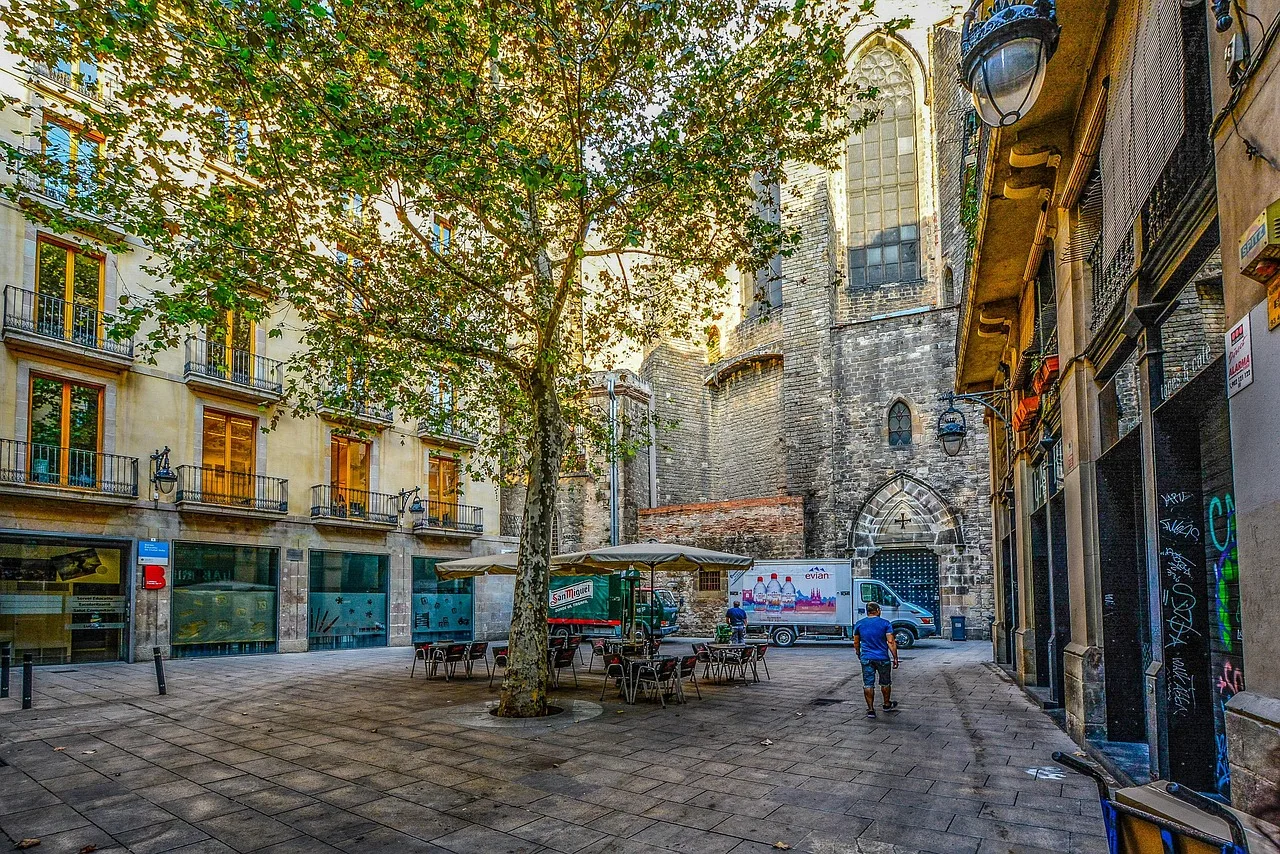
Sant Felip Neri is a small square with a bombed church wall and a school. Two groups is the ceiling because two groups is roughly what fits before the children cannot get out of the door. Choosing a small operator, or a guide who hands out earpieces instead of shouting, is not a nicety. It is the regulation, and it is one of the few visitor-facing rules where compliance is visible from across a square.
The Boqueria is a shop
The market's own president puts its footfall above 25 million visitors a year across 178 stalls. For eight years it has restricted organised groups of fifteen or more on Fridays and Saturdays through the April to October season, at the stallholders' request, and security staff walk oversized groups back out.
More interesting is what happens next. Vendors voted by more than ninety per cent to accept a reform and a new internal rulebook that would fix the balance of the market's offer at roughly fifty-four per cent traditional fresh produce to forty-six per cent prepared food to take away, with a little flexibility by speciality. The point is undisguised: the juice-and-fruit-cup economy had been squeezing out the fishmongers, and the council intends to reverse that.
The building work has not started. It is out to tender, and the plan is to open with the central fish island and a reordering of stalls to widen the aisles, then keep going through 2027 and 2028. The market stays trading the whole time by moving stallholders out in phases into a marquee on Plaça de la Gardunya, the fish counters going first, which is worth knowing if you turn up expecting the fish to be where the photographs say it is. A later phase, covering the asbestos roof and the Gardunya façade, runs past the current mandate. La Rambla outside is itself being rebuilt, with completion targeted for early 2027.
So the honest advice about the Boqueria is that it is a food market with a queue problem, and the way to be welcome in it is to buy something from a stall that sells raw ingredients, early, without a group. Or to go to Santa Caterina or Sant Antoni instead, which are also municipal markets, also historic, and roughly a third the size in stall count.
Park Güell tells you the hours it wants you
The ticket buys you twelve hectares, not the park. Barcelona put access controls on the monumental area in October 2013, and the ticketed part is still that area: the mosaic terrace, the dragon stairway, the hypostyle hall, held to a ceiling of 1,400 visitors an hour. The eight hectares of woodland alongside it stay free and ungated, and are used by people from the surrounding barris for exactly what a park is for. The regulated perimeter was widened in 2020 to take in the whole site, which is not the same thing as putting a turnstile on it, whatever the ticket resellers would like you to conclude.
Inside the paid area the numbers sit just under a capacity ceiling of four and a half million, of which only around half a million are residents entering on the neighbourhood card. The council has withdrawn on-the-door ticket sales entirely and has committed to cutting that ceiling by half a million over two years.
It has also, in the centenary year of the park's opening to the public, made entry free and effectively frictionless for anyone on the municipal register, and it has fenced off two windows of the day, early morning and evening, in which no tickets are sold to visitors at all. Residents of the six adjoining neighbourhoods hold a card that admits them throughout opening hours through three gates reserved for them.
Those reserved hours are the clearest statement the city has made about what it wants back. Book ahead, arrive inside your slot, and treat the early and late windows as somebody else's. The same logic applies across the sixteen high-attendance spaces: the crowd is a schedule, not a fact.
The money already has an opinion
Catalonia levies a per-night tax on tourist stays, and Barcelona adds a municipal surcharge on top of it, collected through the Catalan tax agency. The design is worth understanding even if the rates change, because the rates are pointed. Cruise passengers on a call of twelve hours or less pay a higher headline rate than those on a longer call. Tourist flats are taxed above hotels of comparable standing. The council's strategy document states the reasoning plainly: fiscal pressure is being used to discourage the formats that generate the least social return and the most externality, and to make them contribute to the cleaning, maintenance and policing they consume.
The port is moving the same way. The city and the Port of Barcelona have agreed to cut cruise terminals from seven to five by 2030, demolishing the three oldest and building one new public terminal, which reduces maximum daily cruise capacity by sixteen per cent. Mayor Jaume Collboni called it a first: "Today, for the first time in history, a limit is being placed on the growth of cruise ships in Barcelona."
Format, then, is the lever the city has chosen. Rank the tax schedule and it reads like a verdict: a hostel bed at the bottom, a four-star room above it, a tourist flat above the four-star, a twelve-hour cruise call above the flat, and only the five-star suites paying more than any of them. That is not a moral ranking of tourists. It is a price list for the shapes of visit the city finds hardest to absorb.
The small print that catches people
Walking through public space bare-chested is now a specific offence, with its own band of fines, unless you are doing something athletic. Smoking is prohibited on every Barcelona beach, all year, on the sand and in the water, with the seasonal beach bars as the only exception. Dropping a cup or a tissue is sanctionable. And buying anything from an unlicensed street seller is itself an offence, alongside selling: the purchaser is named in the schedule, not just the vendor.
None of this is enforced with drones. Most of it is enforced by a police officer deciding whether you were the reason someone complained.
Barcelona has done something unusual for a city under pressure: it has written down, in public, in enforceable language, exactly which behaviours it can no longer absorb and exactly which streets and squares and hours it wants held in reserve. Almost nobody reads it, which is a shame, because it is a far better guide to the city than most of what is written for visitors. The 116 still runs up the hill, on the same route it always did. You can find it if you look. The city would simply rather you walked.
Sources
- Mesura de Govern per a la Gestió Turística 2024-2027 (Ajuntament de Barcelona, PDF) - 170,000 tourists on an average day, the district density map from 14,177 per km2 in Ciutat Vella down to 104, the fifteen high-attendance spaces identified at the time, the Boqueria as a fragile space, and the stated intent of taxing short cruise calls and tourist flats more heavily
- Enquesta de percepció del turisme a Barcelona 2025 (Oficina Municipal de Dades, PDF) - 76.7% choosing the "està arribant / ha arribat al límit" option, 57.6% avoiding parts of the city, 54.7% in tourist neighbourhoods feeling personally harmed
- L'accés a l'habitatge es consolida com el primer problema per als barcelonins (betevé) - municipal barometer ranking housing first, tourism far down the list, 87.4% backing tougher antisocial-behaviour penalties
- Barcelona no renovará las licencias de viviendas de uso turístico (Ajuntament de Barcelona) - 10,000 licences expiring by November 2028, no tourist-flat category in the PEUAT, about 300 complaints a month
- Un 84% de los viajeros de negocios del MWC apoya mantener los pisos turísticos en Barcelona (Hosteltur) - Apartur's contentious-administrative appeal at the Catalan high court, its request for a reference to the EU Court of Justice on services-directive grounds, and the late-2026 or early-2027 timetable for that decision
- La justicia avala la iniciativa del Ayuntamiento de Barcelona para limitar los pisos turísticos (Metrópoli) - three Catalan high court rulings dismissing the challenges to the PEUAT
- Fines for the coexistence bye-law, Pla Endreça (Barcelona City Council) - the revised schedule of sanctions: pub crawls, disturbing residents' rest, bare torso, littering, buying from unlicensed street sellers, plus Guàrdia Urbana report counts
- Entra en vigor la nova Ordenança de Convivència (Ajuntament de Barcelona) - the 2005 original, the December 2025 plenary approval and the February 2026 entry into force, twenty years on
- Comença el control dels grups turístics a Ciutat Vella (Ajuntament de Barcelona, press office) - twenty-person cap, loudspeaker ban, the full list of twelve capped spaces and the penalty range
- Ciutat Vella blinda fins al 2028 els decrets de prohibició de rutes alcohòliques i de limitació de grups turístics (Ajuntament de Barcelona) - the 23:00 to 07:00 pub-crawl ban since 2012, extended to 2028, and who the fines attach to
- Park Güell regulation and why the access points are regulated (Web oficial Park Güell) - access controls on the monumental area since October 2013, the twelve hectares the ticket covers, the eight further hectares of free woodland, and the 1,400 visitors per hour ceiling
- Barcelona apropa el Park Güell a la ciutadania l'any del centenari (Ajuntament de Barcelona) - free resident entry via the municipal register, the reserved early and late windows, withdrawal of door sales, the pledge to cut capacity by 500,000, and the three neighbourhood-only gates
- El bus 116 s'amaga a Google i els turistes han de buscar alternatives per anar al Park Güell (3Cat) - the residents' petition for more frequency or an alternative, the removal of route 116 from mapping tools, and the four and a half million capacity ceiling at Park Güell
- El mercado de la Boqueria valida por mayoría la reforma (Info Barcelona, Ajuntament de Barcelona) - the vendors' vote, the 53.7 to 46.3 split between traditional and prepared produce, the phasing of the works, and the Boqueria and Gardunya counted as one of the sixteen high-attendance spaces
- Les parades de la Boqueria aniran a una carpa a la plaça de la Gardunya durant les obres del mercat (betevé) - works still out to tender, the phased move into a marquee on Plaça de la Gardunya with the fish stalls first, and works continuing through 2027 and 2028
- La Boqueria analitza els moviments dels seus 25 milions de visitants anuals (Mercat de la Boqueria) - the market association president's figure of more than 25 million visitors a year
- La nova Boqueria vol atraure més veïns i limitarà el producte elaborat (3Cat) - the eight-year-old restriction on groups of fifteen or more on Fridays and Saturdays from April to October, and stall counts at the Boqueria, Sant Antoni and Santa Caterina
- Quota tributària i tarifes, impost sobre les estades en establiments turístics (Agència Tributària de Catalunya) - the Barcelona rate table and municipal surcharge, ranking hostels lowest, then four-star hotels, then tourist flats, then cruise calls of twelve hours or less, with five-star establishments highest
- Barcelona moves to limit cruise tourism by reducing terminals from 7 to 5 (Catalan News) - the council and port agreement, demolition of three terminals, the 16% cut in daily cruise capacity, and the mayor's quoted remark
- Aprovada la modificació de l'ordenança per prohibir fumar a totes les platges de la ciutat (Ajuntament de Barcelona) - the year-round beach smoking ban on sand and in the water, with the seasonal beach bars excepted
- Reforma de la Rambla (Pla d'Acció de Govern, Ajuntament de Barcelona) - the scope of the Rambla rebuild and its February 2027 completion target