Where to Eat in Lima When the Famous Places Are Booked Out
LineCast Networks
Avenida Pedro de Osma 301, in the Barranco district of Lima, is a single street number with two of the most contested dining rooms in South America behind it. Central is at that address. So is Kjolle, which has its own kitchen, its own tasting menu, its own reservations address and, as it happens, the same door number. Between them they absorb most of the anxiety that outsiders bring to this city.
Both also publish, in plain language on their own websites, exactly how to get a table. Central takes online bookings for parties of one to six, up to four months in advance; larger groups go by email. Maido, over in Miraflores, states that reservations open two months ahead, on the first day of each month, for parties of one to ten. Both are closer to an airline seat release than to a velvet rope. People find these tables impossible not because the kitchens are hostile to visitors, but because the visitor arrives on a Tuesday wanting Thursday, and the diary was settled in the spring.
Which is cold comfort if you are already in Lima with nothing booked. The warmer news is that the city's real culinary argument is conducted at lunchtime, in rooms with laminated tablecloths, and almost none of it takes reservations.
Lunch is the serious meal
The institution to learn is the menú. It is Peru's version of the fixed-price set lunch found across the Spanish-speaking world, and in Lima it is everywhere: a chalkboard or a plastic-sleeved card propped on the pavement outside a small room, listing two or three starters, two or three mains and a drink, all for one price. You order the entrada, the segundo and the refresco that comes with it, usually a jug of something purple or yellow made from whatever fruit was cheap that morning.
The economics explain the quality. A menú kitchen buys at dawn, cooks a short list, and turns the room over between roughly one and three o'clock, when the offices empty. It cannot afford a long carte and it cannot afford to be mediocre, because the same accountants and mechanics eat there four days a week and will walk one door further if the stew is dry. The board changes daily. That is the signal worth watching for: a laminated, permanent menú is a room that has stopped cooking and started reheating.
What arrives is home cooking rather than restaurant cooking. A soup or a plate of potatoes under a yellow chilli sauce, then something braised, stewed or fried over rice. It is built to feed a room quickly and cheaply, and it does that. It also tells you more about how Peruvians actually eat than three tasting menus will, and it does so in about forty minutes.
Ceviche runs on a clock
In December 2023, at its session in Kasane, UNESCO's intergovernmental committee inscribed the element Peru had nominated: "Practices and meanings associated with the preparation and consumption of ceviche, an expression of Peruvian traditional cuisine". The decision document rewards reading, because of what it chooses to emphasise. It records that Peru had already declared the dish Cultural Heritage of the Nation by national resolution in 2004, on a petition from the Congress of the Republic. It names the annual feast of Saint Peter, patron saint of the artisanal fishers. It counts the bearers broadly: fishers and their families, farming families, cooks in seafood kitchens, and anyone in Peru who eats ceviche or makes it at home. And it singles out cevicherías as a traditional space, one "where the work of traditional female cooks stands out".
Peru's culture ministry makes the same point from its side. It calls the inscription the first time an element of Peruvian traditional cooking has reached the list, and it spells out who the recognition is meant to reach: the artisanal fishers of the coast, the Andes and the Amazon, along with the farmers and the traditional cooks. The aim was to make the whole chain visible rather than the plate at the end of it. The state also keeps a national ceviche day on 28 June, which the production ministry uses to promote consumption and, more usefully, to support small-boat fishing.
All of that is background to one practical rule. Ceviche in Lima is a daytime dish. The chain from boat to plate is short by design, and the cevicherías that take it seriously keep midday hours and then stop. If a dining room is selling you ceviche at ten at night, the odds are that it spent the afternoon in a chiller. The convention is not written into any statute and individual hours vary, so check before you walk, but the pattern holds across the serious end of the trade, and it is the single most useful thing to know about eating in this city.
Order accordingly. Sole, lenguado, is the Lima fish; corvina is the older standard. It comes cubed and dressed in lime with sliced onion and chilli, with sweet potato and toasted corn alongside to blunt the acid. Ask for the leche de tigre, the marinade served on its own in a small glass. It is not a garnish. It is the concentrated argument of the dish, and in most places it is the thing the kitchen is quietly proudest of.
Tiradito is worth knowing as the near relative: same raw fish, sliced rather than cubed, sauced at the moment of service rather than marinated in advance. It is a good order at a place you are not yet sure about, because there is nowhere to hide.
Surquillo, and the counter
Surquillo is a small, unglamorous district wedged against Miraflores, and its market is the reason people cross the bridge into it. The streets around that market carry a density of huariques, the Peruvian word for a modest place that does one thing extremely well and has no interest in being found.
The format to look for is the counter. Six to a dozen stools, one cook working in front of you, a menu of perhaps eight items chalked on the wall. Al Toke Pez is the version of this that got famous, run by Tomás Matsufuji, who has a doctorate in chemistry and applies it to chicharrón de pescado and arroz con mariscos. It is also the reason to check an address twice. After about fourteen years on Avenida Angamos Este, in a room of twenty-eight square metres with eleven seats, Al Toke Pez left Surquillo altogether: it reopened on 12 August 2025 at Calle Manuel Bonilla 113, in Miraflores, because the queue had outgrown the kitchen. Guidebooks and blog posts still send people to the old door. Small independent kitchens move, and in my experience the printed record tends to run about a year behind them.
The counter economy runs on the same logic as the menú. Short list, fast turnover, no reservations, and a queue that forms and dissolves inside two hours. You will stand for ten minutes. You will eat for twenty. Nobody will ask if you are enjoying everything.
The chifa
The other everyday Lima meal descends from the Chinese who arrived in the late nineteenth and early twentieth centuries, mostly from Guangdong, and who settled heavily on the coast and in the capital. Their restaurants became known as chifas, a word the Peruvian Academy's lexicographers trace to a Cantonese phrase meaning to eat cooked rice, and the first of them clustered around Calle Capón, near the central market, in what is still the Barrio Chino. The term itself only took hold in Lima in the 1930s.
A great many Limeños eat chifa on a weeknight, and the standard order barely changes: fried rice, wonton, something in a sweet-sour or tamarind sauce, all in portions calibrated for a table rather than a person. The Barrio Chino restaurants are the historic ones, but every district has its own chifa, generally with a red sign and a queue at the takeaway window.
The dish that escaped the chifa is lomo saltado. Strips of beef stir-fried with red onion and tomato, and the word saltado comes from the same root as sauté, describing a Chinese technique performed in a wok. It arrives with both chips and rice on the same plate, potatoes from the Andes and rice from Asia, which is either a redundancy or the entire history of the country compressed onto a dinner plate, depending on your mood. It is now served in almost every kind of restaurant in Lima, including several with tasting menus.
Carts and tabernas
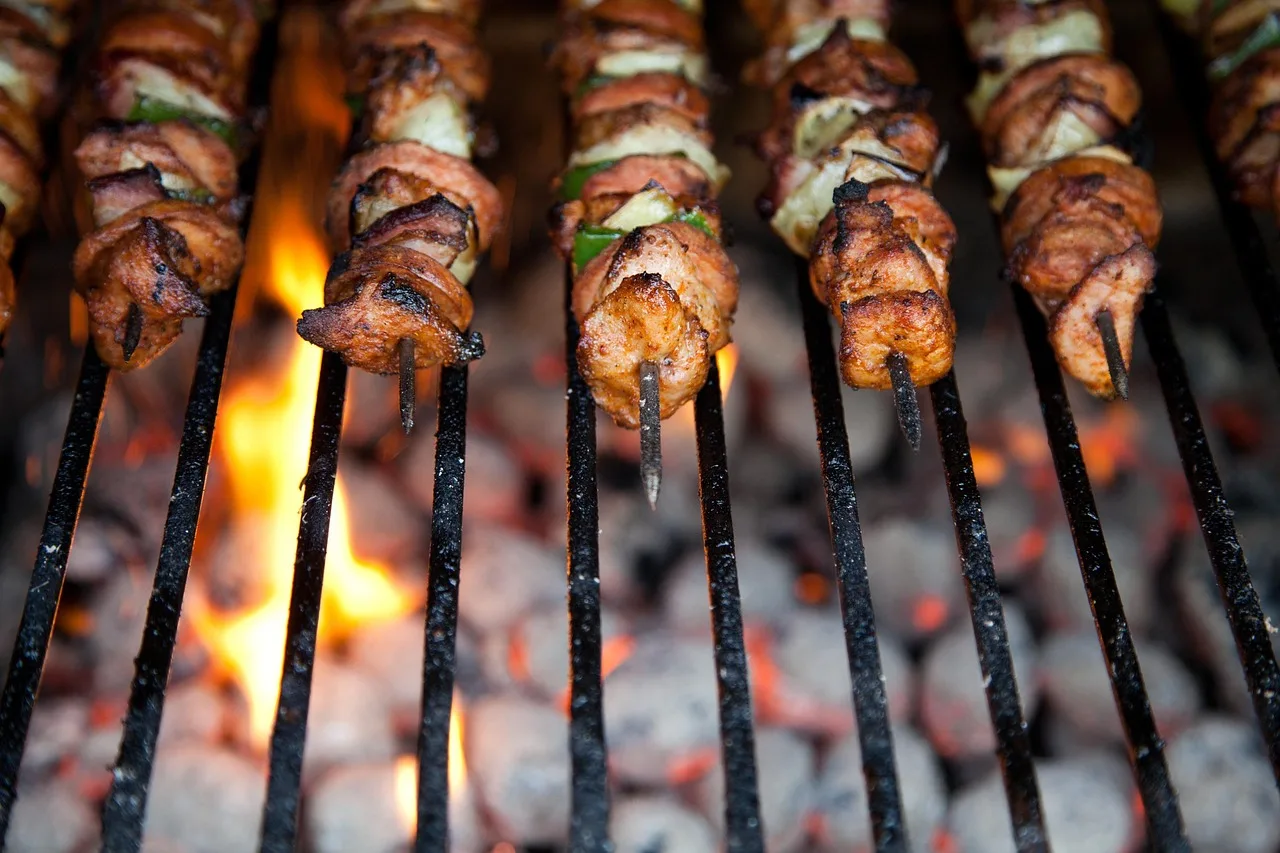
Two more things earn their place. The first is the anticucho: skewers of beef heart, marinated and grilled over charcoal, sold from carts that appear in the evening on street corners and outside stadiums. The dish is old enough that Ricardo Palma described it in the nineteenth century as bisteque en palito, steak on a little stick, eaten by boys and farmhands along the Peruvian coast. Consumption spikes in October, during the Señor de los Milagros processions, when the smoke from the carts becomes part of the city's weather.
The second is the taberna, the old Lima tavern format that has been consciously revived. Isolina in Barranco frames itself explicitly as homage to the tabernas of the past, the sort of place where recipes were written into a notebook and portions were built for sharing. This is criollo cooking at volume: braises, offal, things that took four hours. Book if you can. If you cannot, the published hours are at least in your favour: the Barranco house on Avenida San Martín serves continuously from midday through the afternoon, seven days a week, so a walk-in is not gambling on one seating.
What the reservation is actually for
The tasting menus and the counters are supplied by the same fishers. The UNESCO file that praises the cevichería cook is describing the same value chain that feeds the dining room at Pedro de Osma 301. When a celebrated kitchen sends out a course built on an Amazonian tuber or a fish from a small boat in Chorrillos, it is making an argument about Peru. The argument is a good one and it is worth four months of planning if you have four months.
If you do not, you have not missed the food. You have missed the argument about the food. The food itself is on a chalkboard three streets from wherever you are standing, wiped clean and rewritten every morning by someone who will not remember you and does not need to.
Sources
- Central Restaurante, Reservations - booking window of four months for parties of one to six, the Av. Pedro de Osma 301 address, and the reservas@centralrestaurante.com.pe booking address
- Kjolle - confirms Kjolle occupies the same address, 301 Av. Pedro de Osma, Barranco, and books through its own address, reservas@kjolle.com
- Maido, official site - reservations open two months in advance, on the first day of each month, for parties of one to ten
- UNESCO Intergovernmental Committee decision 18.COM 8.B.4 - the 2023 inscription at Kasane, the full name of the inscribed element, the 2004 national heritage declaration petitioned by Peru's Congress, the festivity of Saint Peter, the list of bearers under criterion R.1, and the reference to traditional female cooks in cevicherías
- Practices and meanings associated with the preparation and consumption of ceviche, UNESCO ICH - the element description, including everyday and festive consumption and the role of cevicherías
- Ceviche, expresión de tradición y diversidad, Ministerio de Cultura del Perú - first element of Peruvian traditional cooking on the list, and the artisanal fishers of the coast, the Andes and the Amazon, together with farmers and traditional cooks
- Día Nacional del Ceviche, Plataforma del Estado Peruano - 28 June as the national ceviche day, the 2004 INC declaration, and the production ministry's aim of supporting artisanal fishers
- El ceviche es motivo de celebración nacional, Ministerio de Relaciones Exteriores - the 28 June observance and the 2023 UNESCO declaration, from a Peruvian government source
- Peruvian ceviche - sole as the Lima fish, corvina as the older standard, sweet potato and toasted corn accompaniments, and leche de tigre served as a glass of marinade
- Tiradito - sliced rather than cubed, sauced at service rather than marinated in advance
- Al toke pez, el huarique de Tomás Matsufuji, se muda, El Comercio, 14 August 2025 - the move from Avenida Angamos Este in Surquillo to Calle Manuel Bonilla 113, Miraflores, on 12 August 2025 after some fourteen years; the twenty-eight square metre room with eleven seats; and the menu of cebiche, chicharrón de pescado and arroz con mariscos
- Chifa - late nineteenth and early twentieth century arrival from Guangdong, settlement on the coast and in Lima, the Cantonese etymology proposed by the lexicographic commission of Peru's language academy, the rise of the term in 1930s Lima, and Calle Capón as the birthplace of the first chifas
- Lomo saltado - Chinese-Peruvian roots, saltado from the same root as sauté, and the pairing of potatoes and rice
- Anticucho (Spanish Wikipedia) - beef heart skewers, Ricardo Palma's bisteque en palito description, and the October peak around the Señor de los Milagros
- Isolina, official site - the restaurant's own framing as homage to old Lima tabernas, the generous sharing portions, and the published Barranco hours at Av. San Martín 101, showing continuous service from midday through the afternoon every day of the week