What Japan Actually Minds, and What Travel Blogs Invented
LineCast Networks
The Kamakura city ordinance that English-language guides describe as a ban on eating in the street bans nothing. Its list of nuisance acts includes, in translation, "eating or drinking while walking in a narrow or crowded place, or other conduct likely to soil another person's clothing." The city's own explanation says the ordinance does not prohibit or regulate eating while walking; it defines nuisance behaviour and asks people to be aware of it. The enforcement mechanism the city points to is a pictogram. The offence being described is not disrespect towards food. It is soy sauce on a stranger's coat.
That gap, between what a rule says and what it becomes after three rounds of retelling, runs through most of what gets written about Japanese manners in English. The pattern is consistent. A specific, practical piece of consideration gets translated into a spiritual absolute, then padded with inventions, and the visitor arrives braced for an exam that nobody is administering.
Here is what is actually written down, and by whom.
Two chopstick rules, and about thirty that are not aimed at you
The Japan National Tourism Organization's food etiquette guide is refreshingly blunt about which chopstick errors matter: "The two biggest no-no's of chopstick use are sticking them vertically in your bowl of rice and passing food from chopsticks to chopsticks."
Both are funeral gestures, which is why they land. Chopsticks standing upright in rice is the bowl set beside the head of the dead in a Buddhist wake. Passing food directly from one pair to another reproduces the moment at a cremation when two mourners lift the same fragment of bone into the urn together. Do either at dinner and you have staged a small funeral over the table. That is a real reaction, and it is not about you being foreign.
The longer catalogues are real too, but they are domestic. The Hashi Wabunka Kenkyukai, a chopstick culture association based in Fukui, lists more than thirty kirai-bashi, the disliked grips: fishing around the bottom of a soup bowl, waving your chopsticks over the dishes while you decide, spearing food, drumming on the bowl to call someone. These are the things a Japanese grandmother corrects in a Japanese eight-year-old. Nobody expects a visitor to have absorbed them.
Two entries on that list are worth knowing because foreign guides mangle them. Watashi-bashi is laying your chopsticks across the top of your bowl in the middle of a meal, and the mid-meal part is the whole of the offence. The association glosses the gesture as meaning "I have finished," so what you have done is inform your host that dinner is over while you are still eating it. Foreign guides drop the qualifier and hand you a flat ban on ever resting your chopsticks on a dish. The other is jikabashi, taking from a shared plate with the ends you have been eating from, listed as poor form in Japan while the same association notes it reads as a mark of friendship in China and on the Korean peninsula.
Meanwhile the rule foreign blogs repeat most often, that rubbing disposable chopsticks together to strip the splinters is a grave insult to the restaurant, is not on that list at all. Nobody invented it, though. Japanese etiquette instructors do teach it, in a considerably milder register: if a splinter appears, pick it off with your fingers rather than sanding the sticks against each other at the table. What crossed the ocean was the instruction without the tone of voice. A small domestic correction, the kind aimed at a teenager at a family dinner, arrived abroad as an offence against the house.
While we are at the table: JNTO tells visitors to feel free to slurp their noodles, and its manners guide adds the clause that gets dropped in translation, which is that you should not feel obliged to. Slurping is permitted, not compulsory. Nobody is grading the volume.
Eating in the street, in context
Nishiki Market in Kyoto asks, in the footer of its own Japanese-language website, that people not eat while walking, because it can cause nuisance and trouble, and that they eat in front of or inside the shop that sold them the food instead. The arcade is 390 metres long and very narrow. The request is about the corridor, not about morality.
Set that against ekiben. Station lunchboxes have existed almost as long as Japanese railways, and JNTO describes buying one before a long journey as one of the definitive experiences of the country. A place that invented an entire genre of food engineered to be eaten in a moving vehicle is not squeamish about food outside a dining room. It is squeamish about crowds.
The distinction is easy to hold once you stop treating it as philosophy. Eat on the shinkansen. Eat standing in front of the takoyaki stall. Do not eat while shuffling through a narrow covered arcade at the pace of the person in front of you.
The queue, the escalator and the phone
Standing on a train platform, you will often notice foot marks painted where the doors will open, and people forming two columns to either side of them. JNTO's guidance is the plain version: line up to the side and let passengers off before boarding. That is the whole rule. It is followed because it is obviously faster, not because of anything ancestral.
The escalator is the case where foreign writing has gone furthest astray. Every guide teaches the same trick, stand left in Tokyo, stand right in Osaka, and treats it as a charming regional quirk. Japanese authorities have spent the last several years trying to kill it.
Saitama Prefecture's escalator ordinance has been in force since October 2021 and places a duty on users to ride standing still, and a duty on facility managers to tell them so. Nagoya City followed in October 2023 with a near identical law whose Article 8 is explicit, in translation, that the obligation holds whether the rider is on the right side or the left. Nagoya's stated reasons are worth reading, because they are not about tidiness. Some people can only grip one handrail. Guide dog users, people carrying children, people with an injured arm. And the machines themselves are certified on the assumption that riders stand still, so walking accelerates wear and can trip an emergency stop. Nagoya has installed AI devices at three subway stations that detect walkers and speak up.
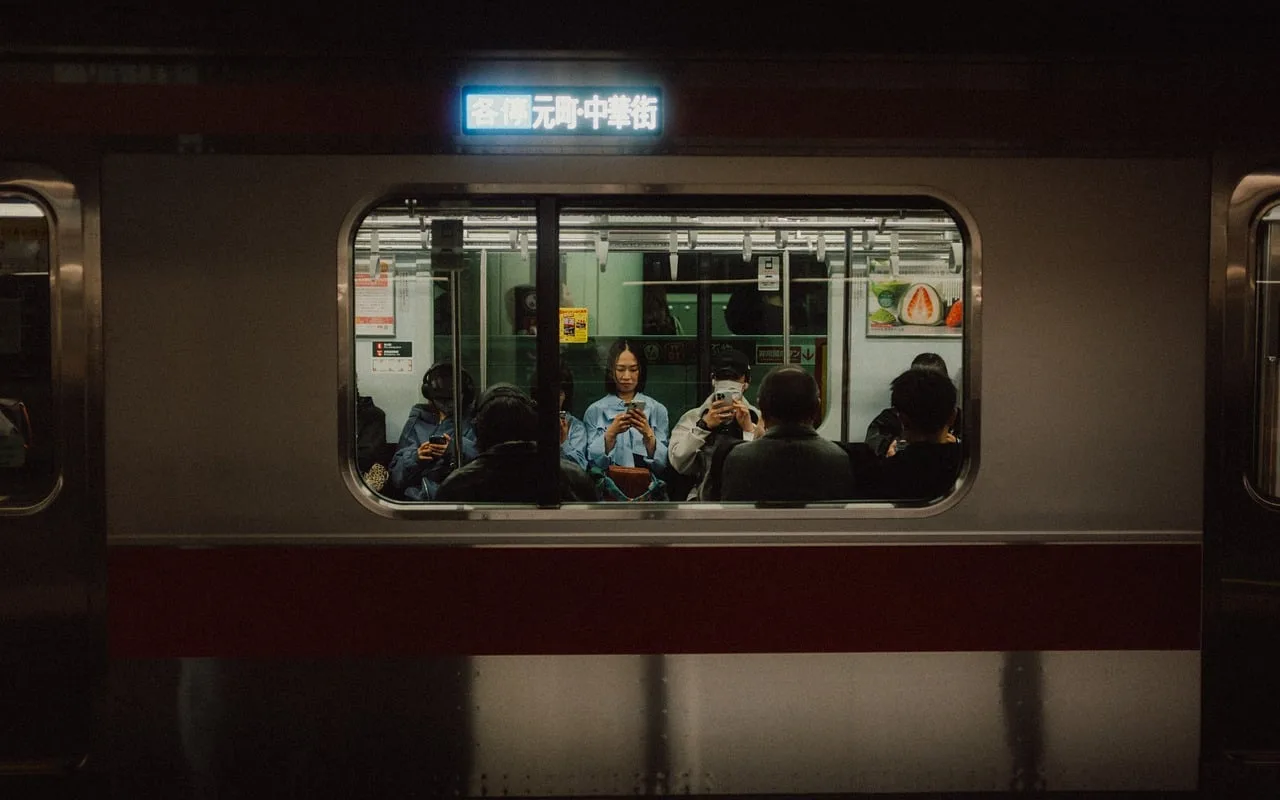
Phones are the other case where the rule got frozen at an earlier version. Kansai's railway operators changed their guidance in July 2014, and JR East plus thirty-six other operators in eastern Japan followed in October 2015, from "turn your phone off near priority seats" to "turn your phone off near priority seats when the train is crowded." The trigger was technical: Japan shut down 2G service in July 2012, and the Ministry of Internal Affairs and Communications revised its guidance on radio interference with implanted medical devices the following January. What survives unchanged, and is enforced by two hundred pairs of eyes, is the rest of the sentence: silent mode, and no voice calls. Texting on a packed Tokyo train is, by common report, unremarkable. Taking a call is the thing people notice.
Shoes, which are about the floor
The shoe rule is real, universal, and simpler than it is usually made to sound. There is a physical line, the genkan, a lowered entrance area inside the door. Shoes come off at that line and go into a shoebox or neatly to one side. Indoor slippers come on. Then slippers come off again at the edge of tatami, and there is usually a separate pair waiting inside the toilet, which is the one that catches people out, because you have to remember to change back.
Nothing about this is reverence. It is a flooring system. Tatami is woven rush and people sit and sleep on it. JNTO's practical note is the useful one: bring shoes you can get in and out of without sitting down, because you will do it several times a day.
Tattoos, which are a house rule rather than a law
No Japanese law bars tattooed people from bathhouses. What exists is a dense mesh of individual facility policies, and they are genuinely restrictive. JNTO's own summary is that a tattoo will as a rule keep you out of an onsen, a sento, a pool or a gym, with exceptions.
The scale has been measured, and the measurement is now old. In 2015 the Japan Tourism Agency sent a questionnaire to 3,768 bathing and lodging facilities and got 581 of them back, a response rate of about 15 per cent. That figure is worth carrying through the rest of the paragraph, because what follows describes roughly one facility in seven, the seventh that chose to answer, eleven years ago. Of those respondents, around 56 per cent refused entry to tattooed bathers, around 31 per cent did not, and around 13 per cent admitted them on conditions such as covering the tattoo with a patch.
The reasons the refusing facilities gave are the interesting part. About 59 per cent said they had decided for themselves, on grounds of propriety and hygiene. Propriety is doing a lot of quiet work in that sentence; it is widely read as the polite Japanese word for the organised-crime association that sits underneath the entire policy, and rendering it as public order or crowd control loses the only thing it means. About 13 per cent cited an agreement among local businesses. Only about 9 per cent pointed to any request or guidance from police or local government.
So this was never a national position being handed down. It was thousands of separate owners each making a call, which is why the outcome varies so much and why asking works.
Where there is a national position, it points the other way. In March 2016 the Japan Tourism Agency wrote to the hotel, ryokan and hot spring associations to say that refusing someone solely because they have a tattoo is not appropriate, that a tattoo creates no hygiene problem, and that facilities should think about cover patches, quieter hours, split bathing areas or a private bath instead. It noted that people are tattooed for religious, cultural and fashion reasons. The Ministry of Health, Labour and Welfare forwarded the whole thing to every prefecture two days later, telling them to ensure refusals were not happening for improper reasons. The 2015 percentages describe the year before that letter went out.
JNTO notes that municipally run baths, outdoor soto-yu and neighbourhood sento tend to be more relaxed, and that covering a small tattoo with a waterproof patch is the safest approach. Private rental baths, kashikiriburo, remove the question entirely.
Tipping, which is not what the guides say it is
The claim that tipping in Japan causes offence is a good deal stronger than anything the official guidance will support. JNTO's whole position is that tipping is simply not common in bars, cafes, restaurants, taxis and hotels, and that on the rare occasion when it does fit, nobody is waiting for it and the handover should be quiet. Not forbidden. Not expected. The word offence never appears, and the silence is the finding: the national tourism body, whose entire job is heading off this kind of foreign anxiety in advance, does not think there is an insult here worth warning you about. Tipping is absent, in the way that haggling over a bus fare is absent.
A gratuity custom does exist, though, and it has a name. Kokorozuke, roughly "coming from the heart," is given in some situations, and JNTO's own example is a private guide or an interpreter used to overseas practice. The form matters more than the amount: cash goes in a small envelope, of the kind sold in any convenience store, stationery shop or hundred-yen store, and it is handed over quietly. Loose notes pressed into a palm is the part that reads as wrong, not the money.
The drinks rule at the same table is the one worth learning instead. Pour for other people, do not pour for yourself, hold the bottle with the label facing up, and tilt your glass slightly when someone pours for you. If you have had enough, leave your glass full. An empty glass is a request.
Nagoya, wanting a slogan for its escalator campaign, put the question to the public and received 1,019 entries from around the country. Among the ones it singled out, in translation: "An escalator has no overtaking lane." The city is arguing with its own commuters. It was never arguing with you.
Sources
- Kamakura City: Ordinance on the Improvement of Manners in Public Places: the ordinance's text on eating while walking, and the city's statement that it prohibits nothing
- JNTO: Japanese Food Etiquette Guide: the two chopstick taboos that matter, and the rules for pouring drinks
- Hashi Wabunka Kenkyukai: Chopstick taboos (kirai-bashi): the full list of disliked grips, watashi-bashi as a mid-meal signal, jikabashi across East Asia, funeral origins, and the absence of any entry on rubbing chopsticks
- Nanairo Style (Chikako Higuchi, etiquette instructor): disposable chopstick manners: Japanese etiquette teaching that splinters should be picked off by hand rather than rubbed away
- JNTO: Understanding and Mastering Japanese Manners and Etiquette: shoes and slippers, bathing, tattoos at onsen and sento, boarding trains, slurping as optional
- Kyoto Nishiki Market Shopping Street official site: the market's own request not to eat while walking, and the 390 metre arcade
- JNTO: Experience Japan's Local Ekiben Culture: station lunchboxes as an established part of train travel
- Saitama Prefecture: Ordinance on the Promotion of Safe Escalator Use: the duty to stand still, in force since 1 October 2021
- Nagoya City: Ordinance on the Promotion of Safe Escalator Use: Article 8, the accessibility and engineering reasoning, detection devices, the 1,019 slogan entries
- JR East FAQ: mobile phone manners on trains: the exact current wording and the October 2015 change across 37 operators
- Osaka Metro: change to mobile phone manners near priority seats: the July 2014 Kansai change, the July 2012 end of 2G service and the January 2013 revision behind it
- Travel Voice: Japan Tourism Agency survey on tattoos at bathing facilities, 22 October 2015: 3,768 facilities surveyed and 581 replies, the 56 / 31 / 13 per cent split, and the reasons facilities gave
- Japan Tourism Agency and Ministry of Health, Labour and Welfare, March 2016: bathing by tattooed foreign visitors: refusal on the sole ground of a tattoo is not appropriate, tattoos raise no hygiene problem, and the suggested accommodations
- JNTO: Tipping in Japan: tipping as uncommon, not expected and done discreetly, and the kokorozuke envelope