Walking George Town in the Cool Hours and Eating in the Hot Ones
LineCast Networks
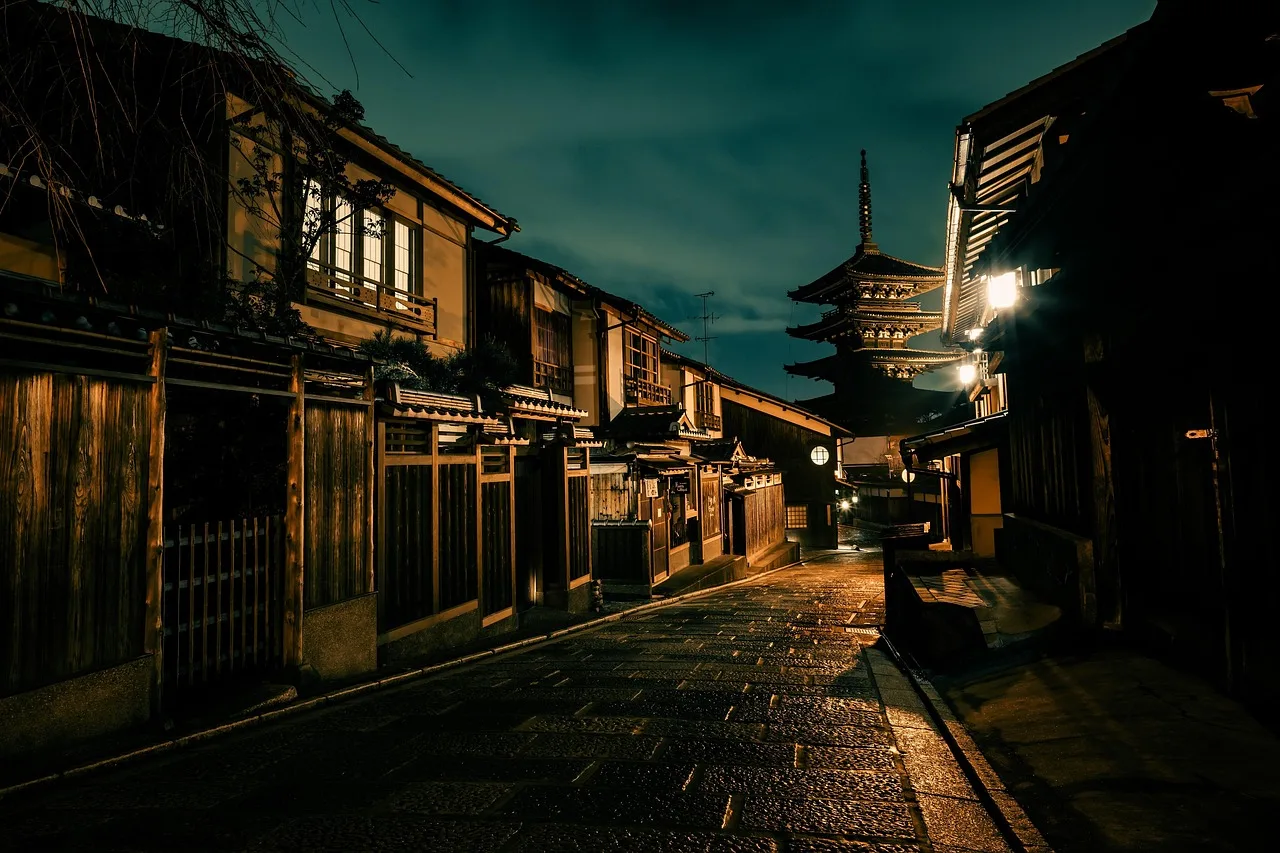
The sun does not stand over George Town at noon. On 15 January the US Naval Observatory puts the sun's upper transit above the city at 13:28. In mid-April it is 13:19, in mid-July 13:25, and in mid-October, earliest of the four, 13:05. Solar noon on Penang arrives somewhere between sixty-five and ninety minutes after the clock says midday, because Malaysia keeps time at UTC+8, a standard meridian that runs closer to Manila than to the Strait of Malacca. Peninsular Malaysia pushed its clocks forward by thirty minutes on the last night of 1981, under the Malaysian Standard Time Act 1981, so the whole federation would agree with Sabah and Sarawak, and there they have stayed.
Which means every piece of inherited advice about avoiding the midday sun is displaced by over an hour, and at the January end of the year by nearly ninety minutes. The punishing stretch of a Penang day is not twelve to two. It is closer to one until five, and the worst of it falls in mid-afternoon, once the granite and the roof tiles have had five hours to load up.
The compensation is that the timetable never moves. George Town sits at five degrees twenty-five minutes north. Across those same four sample dates, spread through the year, sunrise shifted only between 07:04 and 07:33, sunset between 19:05 and 19:37, and civil twilight opened the day between about twenty to seven and ten past. There is no long summer evening to save the walking for, and no dim winter afternoon to write off. A day planned for February works in August. That is rare enough to build on.
So: walk for the first three hours of light, go under a roof for the middle seven, come back out when the sea breeze does, and eat late.
The morning belongs to the arcade
The heritage core is small. George Town World Heritage Incorporated, which manages the site, counts 109.38 hectares in the core zone and 150.04 in the buffer around it, holding 5,013 buildings and 37 places of worship between them. At that size, crossing the whole thing on foot is perhaps half an hour unhurried, going by the area rather than a measured walk. The temptation, given the size, is to wander. Resist it in the morning and walk with a route, because the shade runs in lines and you want to be standing in them.
Those lines are the five foot ways. The Straits Chinese shophouse is narrow at the front and long behind, its ground floor given to trade and its upper floors to the family, and along the street it carries a covered passage cut into the building itself. The rule that produced them began in Singapore: Stamford Raffles's 1822 instructions for the town plan required that each house provide "a verandah of a certain depth, open at all times as a continued and covered passage on each side of the street". The covered passage was later mandated elsewhere in the Straits Settlements, Penang among them, and it became the defining feature of the shophouse street. What it produces in George Town is an unbroken roofed corridor at pavement level, running the length of whole blocks.
It is also, and this is the part nobody writes down, an obstacle course. Five foot ways step up and down between neighbours, because each shophouse built its own. They hold motorbikes, drying laundry, altars, stacked crates, a man having his second coffee. You do not stride down a five foot way, you thread through it, and the trade is worth making: the kerb has no shade at all, and by nine in the morning that is a difference you can feel in your scalp.
A workable line, starting early. Begin at the Goddess of Mercy Temple on Pitt Street, built in 1800 and the oldest Chinese temple in the state. It went up as a seafarers' temple for Mazu, and by an 1824 renovation the principal deity had changed to Guan Yin, reflecting a community that was no longer only Hokkien sailors. It was run by a committee drawn in equal numbers from the Hokkien and the Cantonese, and on that footing it served as council and tribunal for Chinese Penang until about the middle of the nineteenth century. The secular half of the job was formally handed on in 1881, when the Penang Chinese Town Hall was founded to arbitrate for the community. A building can hold a whole political history and still smell mainly of incense at seven in the morning.
Do not go looking for the road to change name further south, because it does not. Pitt Street and Jalan Masjid Kapitan Keling are the colonial name and the Malay one for a single continuous street, and the Malay one is after the Kapitan Keling Mosque, built at the southern end in 1801 by the Indian Muslim community who settled there. World Heritage Incorporated singles out this street and Lebuh Cannon as the places where the coexistence is most legible, and it is not an exaggeration made for brochures. The temple is on it. The mosque is on it. St George's Church went up at the northern end in 1816. One block over on Lebuh Queen, with its back gate opening onto the same road, stands the Arulmigu Sri Mahamariamman Temple, built in 1833 and the oldest Hindu temple in Penang, with gods and goddesses crowding the entrance; the site was already in use for worship by 1801. Little India is around it. Four faiths inside ten minutes, all of them still working buildings rather than exhibits, which is the whole reason the inscription exists.
Turn into Cannon Square for the Leong San Tong Khoo Kongsi, the largest Hokkien clanhouse in Malaysia and the most ornamented building in the city by a distance. What makes it worth the detour is not the roof carving but the setting, which survived intact: a clan association building, a stage for opera, and a row of late nineteenth-century houses for clan members, all turned inward onto a square paved in granite. The Khoos put up their first clanhouse here in 1851. It burned in 1901, and what you walk into now was finished in 1906.
In between came the thing everyone tells you about in this square, and the version everyone tells is compressed. In July 1867 a member of the Toh Peh Kong society was caught looking into premises belonging to a White Flag Malay aligned with the rival Gee Hin. Someone called him a thief and flung a rambutan skin at him. Clubs and stones came out, then firearms, and the police broke it up the same day. The rambutan skin is the detail that survived, and it deserves the demotion: what it started was over by evening. The killing went on through the following weeks, and on 1 August a Toh Peh Kong chief made a false accusation that Gee Hin men had stolen newly dyed cloth, which the lieutenant-governor read afterwards as a manufactured pretext. On 3 August the Toh Peh Kong attacked in force and the fighting ran for ten days: muskets in the streets, arson against rivals' homes and businesses, cannon on rooftops, a village burned out. The police force was too small and the island's garrison had been posted elsewhere. Estimates put the dead above a hundred. The government answered with the 1869 Suppression of Dangerous Societies Ordinance, and the societies were outlawed in time.
Stand in the granite square with that in your head and it is very hard not to read the single entrance and the closed outer face as defensive. I did. But that reading is mine and the dates cut against it: the layout here predates the riots by sixteen years, and the Khoos were not the besieged party in them. Khoo Thean Teik, one of the clan's own leaders, led the Toh Peh Kong.
Finish the morning downhill at Weld Quay, where the clan jetties stand on stilts over the water, each named for the surname of the family that built it. Then get indoors. By half past ten the arcade stops being enough.
The middle of the day is not negotiable
The Malaysian Meteorological Department sums the national climate up in a phrase: "uniform temperature, high humidity and copious rainfall", with winds "generally light". The country sits in what the department calls the equatorial doldrum area, where even in a severe drought "it is extremely rare to have a full day with completely clear sky". That sounds like relief and is not. Broken cloud at five degrees north does very little; the day's swing in relative humidity is larger than the annual one, and the maximum daily average sits above 94 per cent and can touch 100.
The sun is not quite the vertical hammer of legend, but it is close enough to ruin the geometry. Twice a year it passes almost exactly overhead here. On 15 January, the worst case among the four sample dates, it is about twenty-seven degrees off vertical at transit, and even at the December solstice only about twenty-nine. Twenty-seven degrees puts a wall's shadow at half the wall's height, which is a real shadow, but a shallow one that swings off you while you stand in it. Plan on shade you can sit inside, not shade you can lean against.
So the afternoon plan is a roof, and George Town is generously supplied. The Penang State Museum at No. 1 Lebuh Farquhar was shut and has re-launched, which is worth saying plainly because a good deal of guidance still describes it as closed. Its own announcement gives the hours: nine to five, daily, closed on Fridays, and on Chinese New Year and the two Hari Raya holidays, Puasa and Aidiladha. Check before you set out anyway, because opening arrangements move. Turning up on a Friday afternoon with nowhere else planned is a specific and avoidable misery.
Khoo Kongsi also works as an afternoon rather than a morning stop, if you would rather spend first light on the streets. So does a long sit in a kopitiam, which is a legitimate activity and not a failure of nerve. Order a drink, take a marble-topped table, watch the fan turn, and let two hours go.
If you want the murals, this is when I have found the crowds heaviest and the light flattest, which tells you something about how much they are worth relative to the arcade you walked at seven. That is a matter of taste and mine is on record.
The meteorological department also supplies the timing of the release. On bright sunny afternoons, it says, "sea breezes of 10 to 15 knots very often develop and reach up to several tens of kilometres inland". Note that the reach is an upper bound, and that the sentence is about the Malaysian coast in general, not about this channel. The next step is mine rather than the department's: George Town faces a strait a few kilometres wide, and the waterfront is where I have found the air moving first. The Esplanade around five is a genuinely different climate from Lebuh Chulia at three.
The evening is a different trade
Penang's tourist board splits its own food story neatly in two: "early morning coffee shops serving freshly made noodles and traditional breakfasts", and hawker centres that stay busy well into the night. Those are not the same people. The board also says the recipes and the techniques come down through families over decades. What it does not say, and what you work out on the ground, is what that implies about hours. A cook who has made one dish for thirty years makes it when that dish sells. A stall may exist only between seven and eleven in the morning, or only after six in the evening, and the same address may host different traders at different times of day. That last part is the arrangement everyone in Penang describes and nobody writes into a source, so take it as reporting rather than citation.
The practical consequence: ask about hours, not addresses. A recommendation without a time attached is half a recommendation, and the disappointed pilgrimage to a shuttered stall is the most common way a Penang food day goes wrong.
The state names its signatures as assam laksa, char koay teow, nasi kandar, cendol and pasembor, and mentions Nyonya and Jawi Peranakan cooking alongside them. One correction is worth carrying in. Laksa splits two ways at the broth: a rich, spiced coconut curry, or a broth soured with tamarind. Penang's is the sour one, built on mackerel that has been poached and flaked, with pineapple, cucumber, onion, red chilli, mint, laksa leaf and shredded torch ginger flower, and finished with a spoonful of hae ko, a thick sweet shrimp paste. People who met laksa in its creamy form and order confidently in Penang tend to get a surprise. It is a good surprise, but it is a surprise.
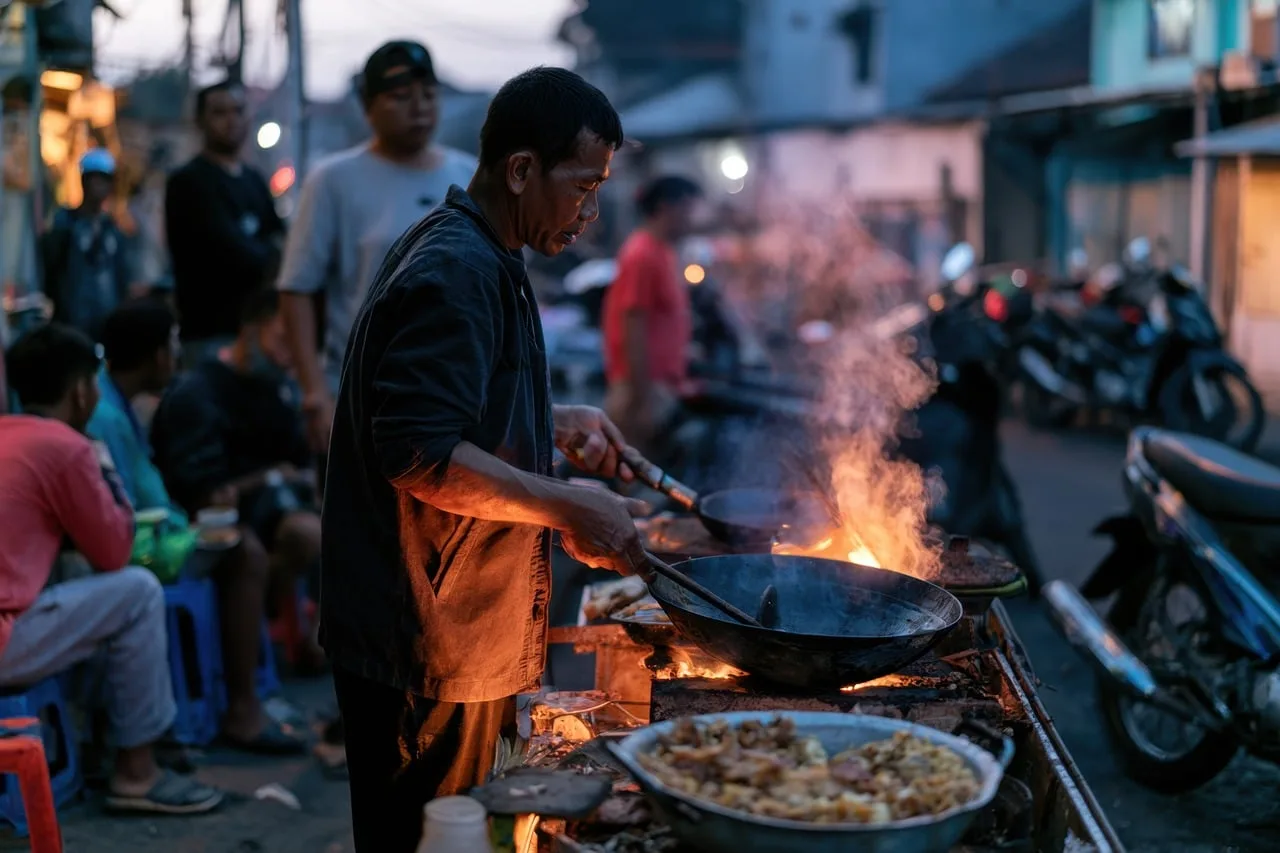
The wok food is the other reason to eat after dark. Char koay teow is, by every account of the technique, cooked over a fierce flame in tiny batches, one or two portions at a time, which is why the queue moves the way it does and why a table of six waits in instalments. Nobody wants to stand next to that burner at three in the afternoon. At eight, with the sea breeze still coming through the shophouse doors, standing next to it is the point.
You will still be eating at nine, which by the sun is somewhere between half past seven and eight. The clock is running an hour and a quarter or so ahead of the island. Eating late in George Town is not late at all.
Sources
- About the George Town UNESCO World Heritage Site - core and buffer zone areas, 5,013 buildings, 37 places of worship including churches, the multi-faith cluster on Jalan Masjid Kapitan Keling and Lebuh Cannon, Little India, and the Weld Quay clan jetties named for clan surnames
- US Naval Observatory, Sun and Moon Rise/Set Data - sunrise, sunset, civil twilight and solar upper transit times for George Town's coordinates on dates across the year
- Malaysia's Climate, Malaysian Meteorological Department - the climate summary and the light winds, the equatorial doldrum area and the rarity of a wholly clear sky, relative humidity varying more daily than annually with a maximum daily average over 94 per cent, and afternoon sea breezes of 10 to 15 knots reaching up to several tens of kilometres inland
- Time in Malaysia - the thirty-minute clock change on 1 January 1982 and the Malaysian Standard Time Act 1981
- Shophouse - the 1822 Raffles verandah instruction and the spread of the mandated five foot way through the Straits Settlements
- Goddess of Mercy Temple - founded 1800 on Pitt Street, Mazu to Guan Yin at the 1824 renovation, the equally split Hokkien and Cantonese committee, its service as council and tribunal until the mid-nineteenth century, and the 1881 founding of the Penang Chinese Town Hall, which assumed the secular role
- Pitt Street, George Town - Pitt Street and Jalan Masjid Kapitan Keling as one street, four faiths within metres of each other, the Kapitan Keling Mosque of 1801 at the southern end and St George's Church of 1816 at the northern
- Sri Mahamariamman Temple, Penang - built 1833, the state's oldest Hindu temple, in use for worship since 1801, on Lebuh Queen with a back entrance on Jalan Masjid Kapitan Keling
- Khoo Kongsi - the largest Hokkien clanhouse in Malaysia, its theatre, association building and rowhouses around a granite-paved square, the 1851 clanhouse, the 1901 fire and the 1906 rebuilding, and Khoo Thean Teik's involvement in the 1867 riots
- 1867 Penang riots - the July rambutan skin incident and its containment, the false cloth accusation of 1 August, the coordinated attacks from 3 August and the ten days of fighting, Khoo Thean Teik as leader of the Toh Peh Kong, the absent garrison, the estimated death toll and the 1869 Suppression of Dangerous Societies Ordinance
- Laksa - the coconut curry and tamarind-soured broths, and the Penang version's mackerel, pineapple, cucumber, chilli, mint, torch ginger flower and hae ko
- Food, MyPenang - the state tourism board on morning coffee shops and late-night hawker centres, recipes passed down through families over decades, and the signature dishes
- Announcement: re-launch of the Penang State Museum, Farquhar Street - the museum's re-launch at No. 1 Lebuh Farquhar, its nine to five daily hours, and its closure on Fridays and on three named holidays, Chinese New Year and the two Hari Raya