Mint Tea, Your Right Hand, and How to Be a Guest in Morocco
LineCast Networks
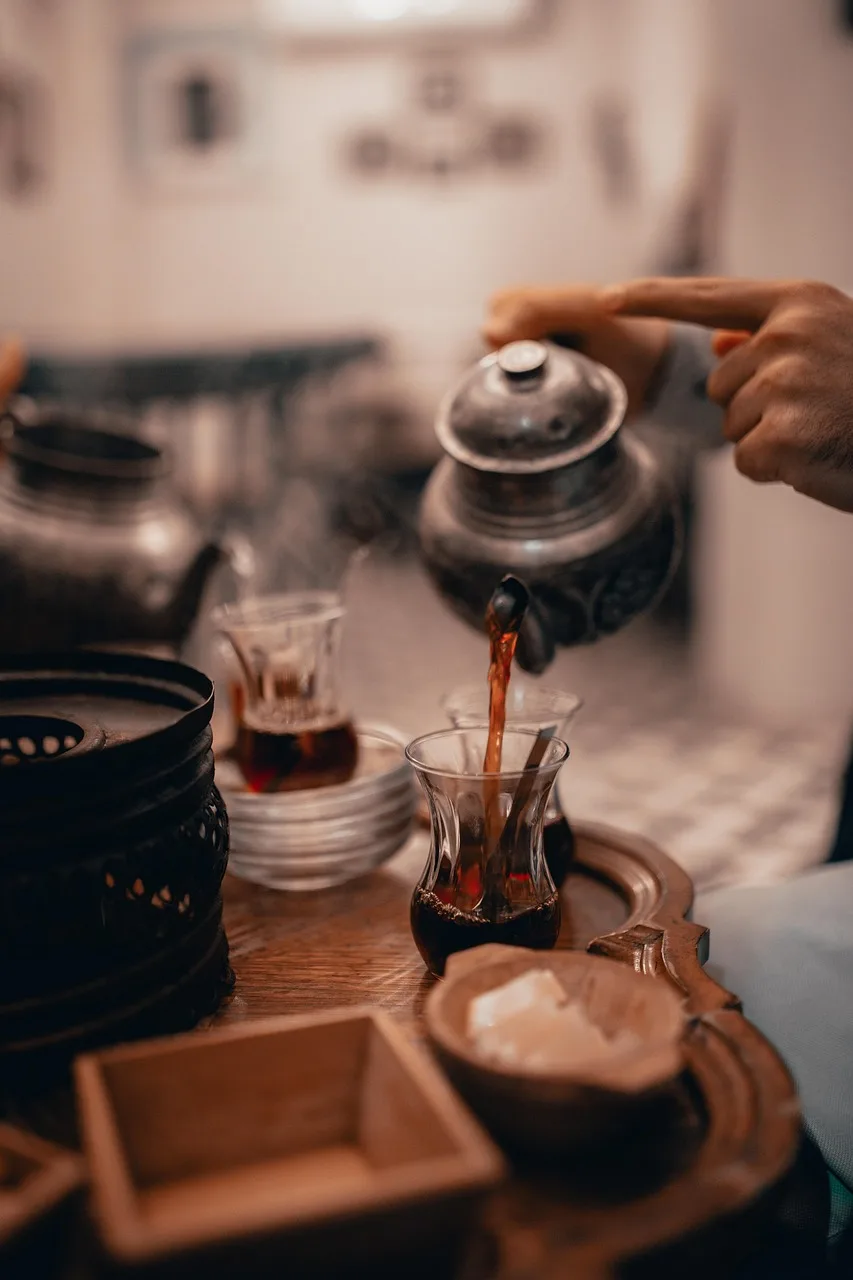
The tea is Chinese.
Morocco grows almost none of it. The leaf in the pot arrived by ship from China, and the country drinks so much of it that it sits near the top of the global ledger. Matthew Barry, insight manager for food and beverage at Euromonitor International, told the Tea & Coffee Trade Journal in May 2024 that "China by itself is roughly half the global market, followed by Morocco, Indonesia, and Japan." A nation of 36,828,330 people at its 2024 census, call it 37 million now, sits second in the world. The mint is local. The sugar is local. The dented aluminium tray, the little glasses, the pot with the long curved spout: all local. The one thing in the ritual that is not Moroccan is the tea.
That is the shape of nearly everything a visitor gets told about Moroccan custom. The object is unremarkable. The procedure around it is elaborate, and the procedure is where the rules live. Get the procedure roughly right and the country is extraordinarily easy to be in. Get it wrong and nobody will tell you, which is worse.
Hospitality is a duty, not a favour
The Moroccan National Tourism Office says the quiet part on its own website. When you are invited, you are served tea, people get to know one another over it, and "it's hard to decline any such invitation even when you've just had a drink a while ago." That is a national tourist board conceding that its country's welcome is not optional.
Take it literally. An offer of tea is not a courtesy you weigh on the merits. It is the opening of an account, and the obligations run in both directions. Your host is obliged to feed you well beyond the point of sense. You are obliged to sit still while it happens.
The practical consequence is time. Being served takes a long while on purpose, and the length is the message. If you genuinely have to be somewhere in half an hour, say so as you sit down, warmly and with an apology. Announcing it as you stand up converts a hospitality into a snub.
The greeting is longer than you expect
By the convention Moroccans and long-term visitors both describe, the exchange is as-salamu alaykum and wa alaykum as-salam, followed by a handshake, followed in many encounters by the right hand touched to the heart. Then comes a round of enquiry: how are you, how is the family, how is the health, is everything well. It is asked and answered more than once, and the answers are not information. They are the transaction. Cutting it short to get to your actual question is the single most common thing foreign visitors do wrong, and it reads as brusqueness rather than efficiency.
Across genders, let the other person put a hand out first. If no hand appears, a hand laid on your own chest with a nod is complete, courteous and unremarkable. Nobody is offended by the version you did not do.
On public conduct, the Canadian government's advice is unusually direct: dress conservatively, keep your behaviour discreet, and expect affection in public to be frowned on.
Then there is a rule that visitors are handed, over and over, in a form that is simply wrong, and wrong in the comfortable direction. Article 490 of the Moroccan penal code makes sexual relations between an unmarried man and woman a criminal offence, and no repeal has been reported. Human Rights Watch, reading the same provision, gives the penalty as "between one month and one year in prison." The article is not written to apply only to Moroccans. It stands on the books for everyone standing on Moroccan soil, and it is not a museum piece: working from the Public Prosecutor's report on criminal policy for 2024, the association Mobilising for Rights Associates counted more than 12,300 prosecutions in that single year under articles 490 and 491.
What the foreign ministries describe is not an exemption from the law. It is a pattern of practice around it, and the practice is mostly about paperwork at a hotel desk. The UK's advice calls unmarried sex and adultery offences for Moroccan nationals, then adds that "the law regarding unmarried people sharing a hotel room does not generally apply to visiting foreign nationals, particularly in popular tourist areas." Canada is narrower still and says exactly what the exemption covers: hotels may turn a couple away if they cannot show they are married, but "foreigners, however, are almost always exempt from having to provide proof."
Read that as a guest, not as a tourist. Two foreign visitors sharing a room in a tourist town are, in practice, left alone. A foreign visitor and a Moroccan friend are not in the same position at all, and the weight falls on the Moroccan, who has no front-desk convention working in their favour and no consulate to telephone. The reassurance you were given describes how the rule is enforced. It does not say the rule is not there.
The right hand is not a quirk, it is a text
There is a specific hadith behind it, in Sahih Muslim's Book of Drinks, under the chapter on the etiquette of eating and drinking and the rulings thereon. Ibn 'Umar reports the Prophet saying: "When any one of you intends to eat (meal), he should eat with his right hand, and when he (intends) to drink he should drink with his right hand, for the Satan eats with his left hand and drinks with his left hand."
That second half is the half that does the work. Without it you have a preference about cutlery. With it you have an assignment: one hand belongs to the meal, the other belongs to the opposition.
So the right hand goes to the shared dish, to the bread, to the glass, to a gift, to a handshake. The left hand does everything else. This is not a preference you are humouring. It has a text behind it, it costs you nothing, and it is noticed instantly.
At the table, the dish usually sits in the middle and everybody eats from it. The convention visitors are taught is to work the wedge directly in front of you rather than ranging across the whole surface, and to let bread do the work of cutlery. Your host will push the better pieces of meat or vegetable towards your side; that is the point of the arrangement, and refusing them defeats it. Say bismillah before you start if you want to; the gesture is welcomed and never mocked.
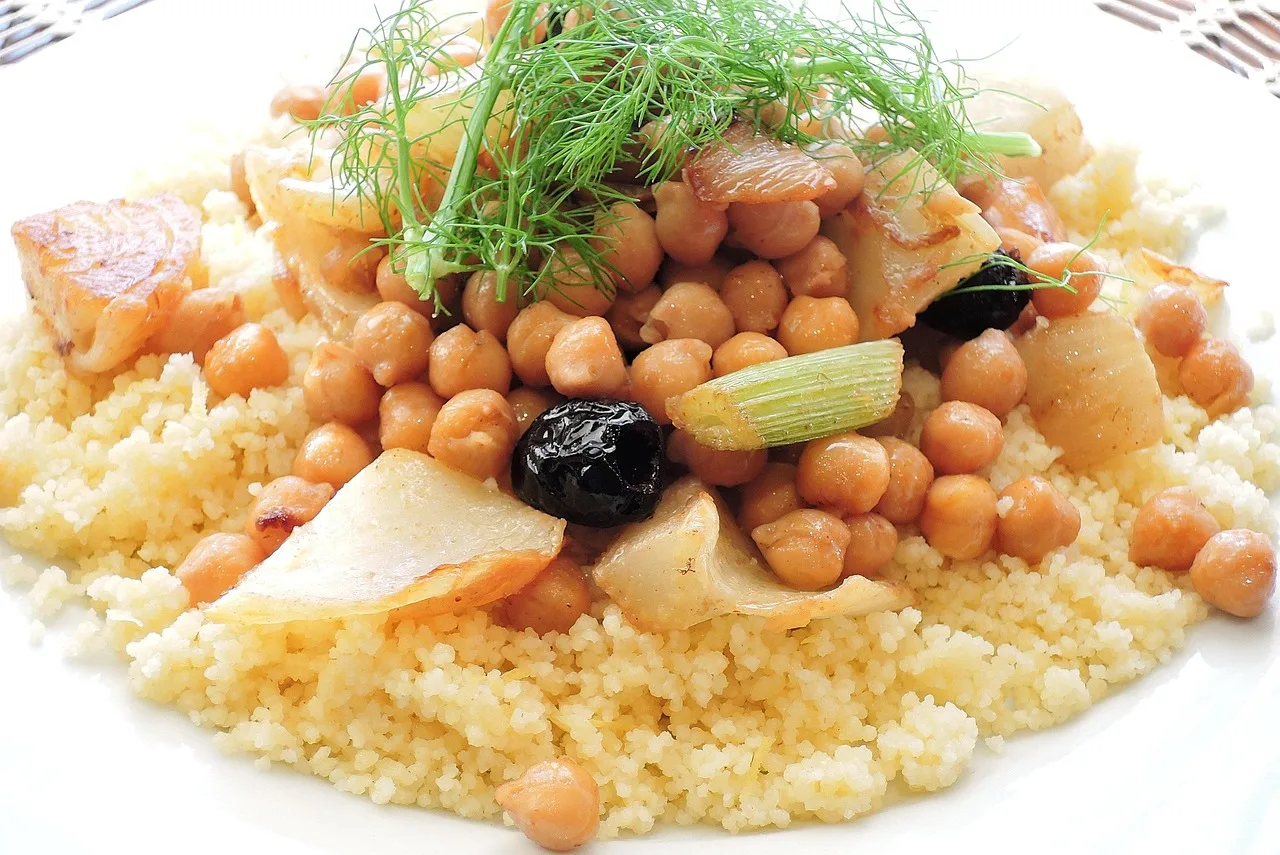
If you want a manual, UNESCO's file on couscous is a better one than most etiquette guides. Couscous was inscribed on the Representative List of Intangible Cultural Heritage in 2020, jointly by Morocco, Algeria, Mauritania and Tunisia, and the inscription describes it as "a dish replete with symbols, meanings and social and cultural dimensions all linked to solidarity, conviviality, sharing meals and togetherness." It also notes that the knowledge is passed on "informally through observation and imitation." That last phrase is your instruction. Watch the table. Copy the table.
How to refuse without causing injury
The governing principle is that a bare refusal is not available to you. What is available is a refusal with a different grammar: accept the offer, decline the quantity, and locate the fault in yourself rather than in the thing offered.
"This is wonderful and I have no room left" works. "No thank you" does not, or rather it works once and then your plate refills while you are looking elsewhere. Regular guests describe stopping the refill with a hand laid lightly over the plate or the glass and a thank you, rather than with an announcement that you are finished. The distinction matters more than it should.
For invitations you truly cannot take, give a specific reason and a specific alternative. Vagueness is heard as distaste. And insha'Allah is widely said to exist precisely for this: both parties are understood to know it can mean no, which is the reason it is useful. It lets the refusal happen without anyone having to perform it.
The same grammar works on the street, with much less warmth behind it. La, shukran, said once, pleasantly, while continuing to walk, is a complete transaction. Repeating it louder is not.
The hammam is infrastructure, not a spa
The tourism office lists what the ritual runs on: ghassoul clay and henna, black soap, rose water and herbs, green clay, and the kessa, the coarse exfoliating glove.
Two quite different institutions share the name. One is the hotel hammam, priced and timed for visitors, with towels and a menu. The other is the neighbourhood hammam, which is where a large part of the country gets clean, separated by sex either by building or by hours of the day. If you go to the second kind, bring or buy your own soap, glove and bucket, keep your eyes to yourself, and copy what everyone around you is doing. Observation and imitation again.
Whether it is open at all is a live question, and the answer has moved. In March 2024 the government ordered the baths shut three days a week to save water, and the numbers that flew around that decision came from people arguing opposite cases. Geographical reported both sides: opponents of the closure put the baths at two per cent of the national supply and pointed out that people barred from a hammam simply shower at home, while supporters put the average at 140 litres for a man and 250 for a woman, multiplied across some 20,000 establishments. Neither figure is a neutral measurement. Both are ammunition.
In December 2024 the interior minister told parliament he had handed the walis and governors discretion to adapt those closures "according to the water situation in each region," citing improved dam levels. The improvement is real and it is partial. After the heavy rain of late 2025, the Sidi Mohamed Ben Abdellah dam near Rabat stood at 84.8 per cent, and the Oued El Makhazin at 82.7. In the same reckoning the Oum Er-Rbia basin had crawled to 8.8 per cent, and national storage across all dams sat at 31.5 per cent in the seventh year of drought.
The upshot is that whether the bath at the end of the street opens on a Tuesday is an administrative question with a regional answer, and the person who knows it is the man behind the counter.
The camera is the fastest way to give offence
Two rules, both from government advice rather than folklore. Photographing near sensitive political or military sites is illegal, and Canada widens that to security installations generally. And permission comes before the picture whenever the subject is a person, with children singled out.
The second rule has an economic edge that visitors miss. Jemaa el-Fna in Marrakesh was proclaimed by UNESCO in 2001 and inscribed on the Representative List in 2008, and protection for the square as part of Morocco's artistic patrimony goes back to 1922. The inscription names the people you are pointing your phone at: storytellers and poets, snake charmers, Berber and Gnaoua musicians, players of the senthir, henna tattooists, water carriers, and practitioners of traditional medicine and fortune telling. They are not set dressing. They are the listed heritage, and they are at work. The same UNESCO file warns that widespread tourism is itself among the pressures on the practice.
So a photograph is a transaction. Agree it in words before the shutter, not after, and settle the amount then. A camera raised without a word is a claim on somebody's income made without asking.
The guide question has a public answer too. The UK's advice is to check that anyone leading you through a medina quarter carries an official badge and has been cleared by the local authority, because people posing as guides work those streets as a matter of routine. Morocco's tourism ministry sets out the framework: the profession is governed by law 05-12, amended several times since, most recently by law 19-22, and it splits guides into two categories, guides of cities and tourist circuits and guides of natural areas. The ministry publishes the accredited names. You can check.
The exception the guidebooks still print
Working mosques in Morocco are generally closed to non-Muslims. The Hassan II Mosque in Casablanca is the famous exception, and its foundation runs paid guided visits along a fixed three-stage circuit: prayer hall, minaret hall, ablutions hall. You go with a guide at a set time or you do not go.
The other exception, repeated for decades, was the Great Mosque of Tinmel in the High Atlas, an Almohad foundation of 1148 raised under Abd al-Mu'min, long out of regular use and open to visitors. By 2023 it was not simply sitting open. An eighteen-month restoration was within months of finishing, and the hand-carved domes and arches had very nearly all been put back.
At 23:11 on 8 September 2023 the earthquake brought the whole thing down. The minaret came off, the prayer hall filled with rubble, the outer walls went over. Villagers carried fifteen of their own dead down the hillside and laid them in front of the ruin; five of the restoration workers were among the dead too. Rebuilding from the original stones has been under way since, and at the most recent reporting available it was not finished. If a guidebook sends you there to walk inside, that guidebook is out of date.
The account you cannot settle
The dirham is a closed currency. The UK's entry guidance calls it "a closed 'non-convertible' currency" and says it cannot easily be exchanged outside Morocco for anything else. Canada goes further: taking dirhams out of the country is illegal, and whatever you have left is changed back at the airport counter on departure, against proof of the currency you bought on the way in. Money enters the country easily and leaves reluctantly, which is a reasonable description of Moroccan hospitality as well.
You will not repay a host in the currency they used on you. What you can do is accept properly. Sit down. Take the glass in your right hand. Ask after the family before you ask for directions. Stay for the second glass, which is the one that says you meant it.
Sources
- Morocco travel advice: safety and security, Foreign, Commonwealth & Development Office - photography permission and sensitive sites, bogus guides and the official badge, the unmarried-couples rule described as illegal for Moroccan nationals and the hotel-room exemption for visiting foreign nationals
- Morocco travel advice: entry requirements, Foreign, Commonwealth & Development Office - the dirham as a closed non-convertible currency that cannot easily be exchanged abroad
- Travel advice and advisories for Morocco, Government of Canada - dress and behaviour, public affection, extramarital relations and the exemption of foreigners from having to provide proof of marriage, photography of military and security installations, the ban on taking dirhams out and reconversion at the airport against proof of purchase
- Morocco: prison terms for adultery, Human Rights Watch - article 490's penalty of between one month and one year in prison for sex between unmarried partners
- Over 12,000 prosecutions for extramarital relations in Morocco, Yabiladi, 15 April 2026 - Mobilising for Rights Associates counting more than 12,300 prosecutions under articles 490 and 491 in 2024, from the Public Prosecutor's criminal policy report
- A land of graciousness, Moroccan National Tourism Office - the tea ceremony as the standard form of welcome and the difficulty of declining an invitation
- Wellness, Moroccan National Tourism Office - hammam ritual elements: ghassoul, henna, black soap, rose water, herbs, green clay and the kessa glove
- Sahih Muslim 2020a, The Book of Drinks, chapter on the etiquette of eating and drinking and the rulings thereon - the textual basis for eating and drinking with the right hand, including the reason clause
- Knowledge, know-how and practices pertaining to the production and consumption of couscous, UNESCO - 2020 inscription, the dish as an expression of sharing and togetherness, transmission by observation and imitation
- Cultural space of Jemaa el-Fna Square, UNESCO - 2001 proclamation and 2008 inscription, protection as national artistic heritage since 1922, the named performers and practitioners, tourism as a pressure on the practice
- Guides de tourisme, Ministère du Tourisme, de l'Artisanat et de l'Économie Sociale et Solidaire - law 05-12 and its amendments up to law 19-22, the two categories of guide, the public register of accredited guides
- Visites guidées payantes, Fondation de la Mosquée Hassan II de Casablanca - paid guided visits at fixed times on a three-stage circuit: salle de prière, hall du minaret, salle des ablutions
- M 6.8 Al Haouz, Morocco, earthquake, US Geological Survey - origin time 22:11 UTC on 8 September 2023, 23:11 local
- Morocco works brick-by-brick to reconstruct 12th-century mosque destroyed by 2023 earthquake, PBS NewsHour / Associated Press, 24 September 2024 - Tinmel mid-restoration when the quake struck, the collapse, the 15 villagers and 5 restoration workers killed, the ongoing rebuild
- Hammans shut down in drought-stricken Morocco, Stuart Butler, Geographical, 14 April 2024 - the March order closing hammams three days a week, and the rival water figures put forward by opponents and supporters of the closure
- Morocco eases restrictions on hammams as water situation improves, Bladi, 4 December 2024 - the interior minister devolving hammam closure decisions to walis and governors region by region
- Heavy rains replenish reservoirs in Morocco, The Water Diplomat, 2 January 2026 - dam-by-dam refill figures from the Ministry of Equipment and Water and national storage still at 31.5 per cent
- Population légale du Royaume du Maroc, Haut-Commissariat au Plan - the 2024 census count of 36,828,330 at 1 September 2024
- Promising new green tea markets offset maturing ones, Eugene Gerden, Tea & Coffee Trade Journal, 9 May 2024 - Matthew Barry of Euromonitor International on China as roughly half the global green tea market, followed by Morocco