In Thailand, Some Etiquette Breaches Are Criminal Offences
LineCast Networks
In 2011 the Associated Press filed a paragraph that roughly every travel forum has ignored ever since. Ladda Thangsupachai, who ran the Thai Culture Ministry's Cultural Surveillance Center, said that tattooing religious images was not yet illegal under Thai law. Her own minister had just gone public, in a statement posted on the ministry's website, calling on tattoo parlours nationwide to stop inking Buddhas onto foreign skin; he had also, the government news agency reported, asked provincial governors to "inspect tattoo studios and seek their cooperation." He was pushing for a law to make the request binding. No law arrived. Fifteen years on, none has.
Meanwhile the British Foreign Office tells people going to Sri Lanka, in plain words on its Sri Lanka page, that "if you have visible tattoos of Buddha, you can be refused entry to Sri Lanka or face deportation." On its Myanmar page it warns that insulting religion is prosecutable there and that the definition "includes tattoos of Buddha." Neither warning appears anywhere on its Thailand page.
The Buddha tattoo rule is real. It just belongs to the neighbours. This is the characteristic way that Southeast Asian etiquette advice goes wrong: a rule that is genuinely enforced in one country migrates across a border and turns up in a Thailand packing list, while the Thai offences, which are drier, more specific and written down in places anyone can read, go unmentioned.
The dress code is a document, not a mood
The Grand Palace in Bangkok is administered by the Bureau of the Royal Household, which publishes its own list of what you may not wear through the gate. The list is worth reading in full because it is nothing like the summary you usually get. In the palace's own words, in its own order:
No sleeveless shirts. No vests. No short top. No see through tops. No short hot pants or short pants. No torn pants. No tight pants. No bike pants. No mini skirts. No pants skirts. No sleeping suit.
Several things follow from the actual text. Ankles appear nowhere on it, though they turn up in a great deal of secondhand advice. Nor is there any mention of loaner or rentable clothing, so arriving under-dressed and expecting to be handed a wrap is a gamble the palace itself has not underwritten.
The scarf is worse than unmentioned. The Thai version of the same official page carries the same eleven items, and one of them is ผ้าคลุมไหล่ทับเสื้อไม่มีแขน: a shawl worn over a sleeveless top. So the palace has not merely declined to endorse the standard workaround. It has written it down as one of the ways to fail.
Most usefully, "No tight pants" and "No bike pants" catch a whole category of visitor who assumed length was the only test. Leggings worn under a long shirt fail this list. So do jeans with fashionable tears, which are barred not for exposure but as torn clothing. And "No pants skirts" rules out culottes. The list ends on "No sleeping suit," which tells you it was written by people who had seen one come through the gate.
Admission at the same compound runs on two regimes. Anyone who can produce a Thai identity card enters free. Everyone else buys a ticket, which also covers Wat Phra Kaew and the textile museum inside the walls. The Bureau also publishes a separate regulation, dated in the Buddhist year 2567, whose title alone tells you enough: "Regulations of the Bureau of the Royal Household Regarding Visits, Filming, Video Recording, and Photography within the Grand Palace." Pointing a camera inside a working royal compound is a regulated activity, not an assumed right.
Wat Pho, ten minutes' walk south, is a functioning monastery rather than a palace, and its guidance differs in ways that matter. Its English visitor page asks for "traditional or polite dress" and states that "shorts above the knees are prohibited for woman." The Thai text on the same site says the same thing. That is an explicitly asymmetric rule, stricter for women than for men, published by the temple itself, and it is the sort of detail that a single universal sentence about covering knees and shoulders flattens into uselessness.
Two further Wat Pho rules are worth carrying to every temple in the country. Shoes come off before you enter any religious building, and go on the shelf by the steps. And the English page states that "Women are also prohibited from all areas set aside for monks to perform their rites." Read only that and you get half a rule. The Thai text of the same page supplies the other half: the monks' seating area is for monks, but laymen are permitted up onto it to help with the rites, and women are not.
Feet at the bottom, heads at the top
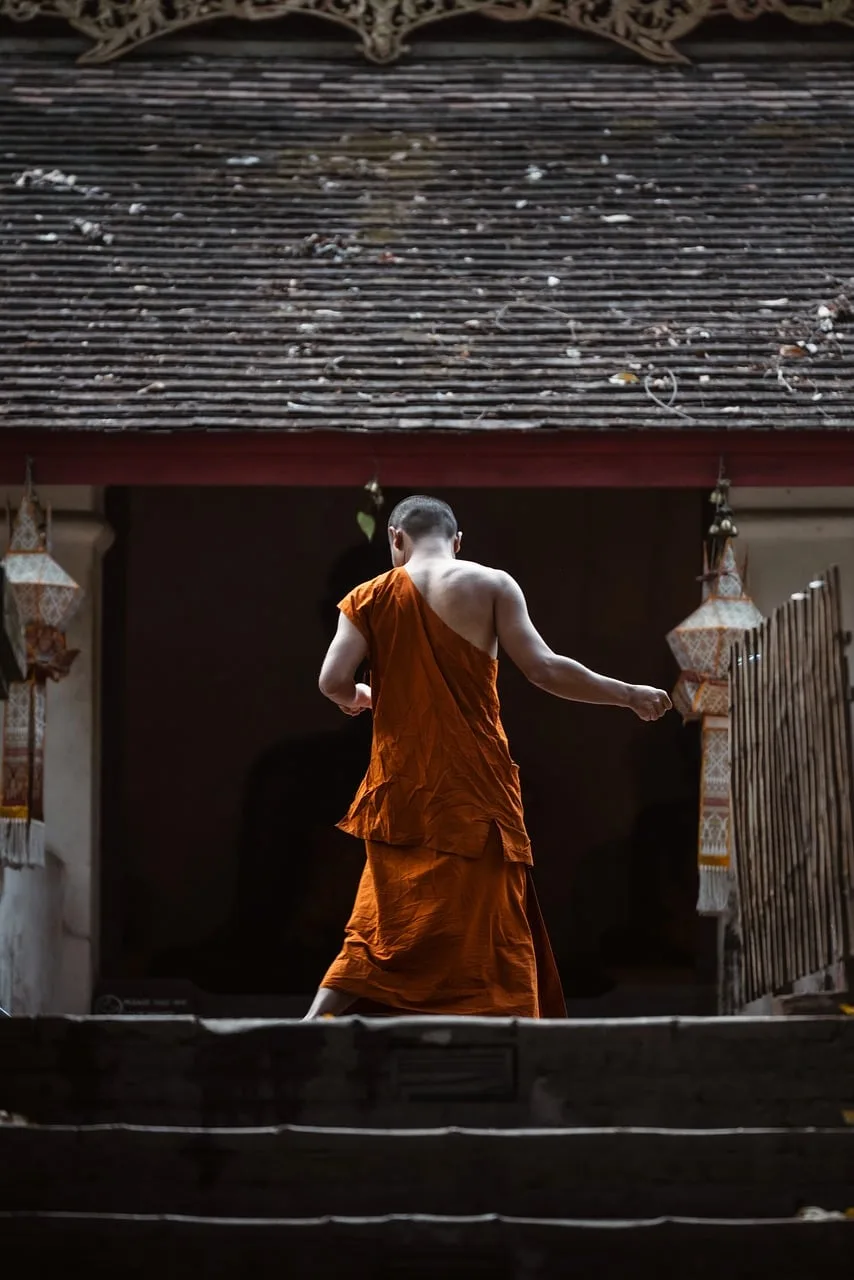
The Royal Thai Embassy in Moscow maintains a page of local law and customs that is about as close as you get to an official Thai statement of the domestic rules. Its instruction on the head is one line: "Don't touch a person's head, nor ruffle his hair. The head is the noblest part of the body." Its instruction on feet is two: do not put your feet on the table while seated, and "never use your foot to point things out or to touch any part of the body of anyone."
These are not abstractions. They are the reason a Buddha image is customarily approached with the soles of your feet turned away from it, the reason a dropped item is not nudged along the floor with a shoe, and the reason the physical layout of a Thai room reads as a hierarchy to anyone raised in it. Wat Pho makes the temple version explicit: photographs alongside a Buddha image are fine, but nobody climbs onto the image, and only authorised staff go up to clean it or place offerings.
The consequences of getting this wrong are not theoretical, and they are not always the consequence you would expect. Two Americans who posted a photograph of their bared backsides taken at Wat Arun were picked up at Don Mueang airport in November 2017 and fined 5,000 baht each for public nudity. The district police chief said at the time that immigration would revoke their visas, push for deportation and blacklist them. What actually happened is a useful corrective to that sentence. They spent two weeks in a Thai jail while police weighed a computer-crime charge and a charge of lewd behaviour at a religious site, and were then released and deported home to California. Neither of the heavier charges was brought. Whether the blacklisting followed was never confirmed. The charge that stuck was not a religious offence at all. That is the practical lesson: several separate bodies of Thai law can reach the same five seconds of behaviour, and the one that reaches you first may be immigration.
The religious offence does exist, though. Section 206 of the Criminal Code reaches anyone who does anything, by any means, to an object or a place that some group of people hold in religious veneration, where the act insults that religion. The Thai text sets the penalty at one to seven years, or a fine, or both. It is not a dead letter of the sort that fills listicles about strange foreign laws: Thai Supreme Court judgments turn on it, and the 2017 amending Act raised its fine tenfold, from a range of 2,000 to 14,000 baht to one of 20,000 to 140,000. Older English translations of the code are still in wide circulation carrying the pre-2017 fine, and some of them render the minimum prison term as two years where the Thai says one, which is a reason to work from the Thai. The embassy page puts the exposure without hedging: "Sacrilegious acts are punishable by imprisonment even if committed by foreign visitors."
Images of the monarchy
Section 112 of the Criminal Code is the one that gets foreigners into genuine trouble, and the gap between what it says and how it is applied is the single most important thing to understand about it.
What it says is narrow. The Thai text is a single sentence, and it names four people: the King, the Queen, the Heir-apparent and the Regent. Whoever defames, insults or expresses malice against any of them faces three to fifteen years. There is no fine alternative anywhere in the section. That is not one translator's reading, either: two independent English versions of the code, one published by a Bangkok law firm and one archived in the Antislavery in Domestic Legislation database, give the same four names and the same three-to-fifteen-year term.
How it is applied is wider. The Foreign Office's Thailand advice states that the law "can be interpreted broadly," that it "also covers any accusations about members of the Thai Royal Family, past and present," and that British nationals, among others, have faced charges over political comments and over sharing articles online that could be read as negative towards the institution. Plan around the wider reading, not the four names.
Royal imagery in Thailand is not confined to palaces and official buildings. Every note in the Bank of Thailand's current Series 17 carries a portrait of the reigning King on the front and portraits of earlier kings on the back. The money in your pocket is a royal image. This is the origin of the widely repeated instruction about not stopping a rolling banknote with your foot, an instruction that follows logically from both the foot rule and the portrait, though I could find no Thai statute making that specific act an offence in its own right. The offence in the statute is defamation, insult or malice, and intent is the thing prosecutors argue about.
One more, easily missed: the same Foreign Office page warns that it can be a crime in Thailand to post a photograph of somebody with a drink in hand, or dressed in a way the authorities judge unsuitable, and that the exposure runs to everyone in the frame, not only to whoever uploaded it. Fines and prison are both on the table. The camera is a legal instrument here in a way it is not at home.
The souvenir you cannot take home
The Thai Customs Department publishes a two-part list. Prohibited goods, which include narcotics, counterfeit currency and CITES-listed wildlife, may not cross the border in either direction. Restricted goods may, but only with a permit from a named agency. The first entry on the restricted list is "Buddha image, artifact/objects, antique," and the named agency is the Fine Arts Department.
That is the same footing as firearms, live animals and pharmaceuticals. The Royal Thai Embassy repeats it independently. It is a licence regime: the application goes to the Fine Arts Department, and the Department decides. It is not something you resolve at a departure gate at four in the morning with a boxed souvenir under your arm.
Guidebooks and shop owners will quote you a size threshold below which no permit is needed. The customs page itself states no threshold. Since the downside is confiscation and a customs offence, the sensible reading is the department's, not the vendor's.
How the wai actually works
The embassy page describes the greeting in one item and then, two items later, quietly explains the mechanism. Item six says that Thais traditionally greet one another with a wai, palms pressed together at the chest, and that a wai offered to you should be returned, with a single exception written into the same line: not when the wai comes from a child. Item seven, listing what a Thai smile is for, supplies the rest of the machinery. A smile is used, among other things, "to return the 'wai' ... of children and inferior persons."
Read those together and the shape of the thing appears. The wai is not a handshake. It is not a symmetric exchange between equals, which is why the child is carved out as an exception and why a smile is an adequate reply from a senior to a junior. A wai encodes who is junior to whom, and offering one indiscriminately, at every waiter, driver and shop assistant, is not extra politeness. It is a statement about relative rank that you almost certainly did not mean to make.
The workable posture for a visitor is narrow and easy: return a wai that is offered to you, at chest height, without the deep bow, and do not initiate one at people who are working. Nobody will think less of you for a nod and a smile.
The exception is monks, and it is not a matter of taste. The embassy states it flatly: "Ladies must not on any account touch a Buddhist monk, give things direct to him or receive things direct from him." Wat Pho's own visitor page says the same, and its Thai text gives the reason: it is a พุทธบัญญัติ, a rule laid down in the monastic code rather than a local preference, which is why it holds regardless of what an individual monk might tolerate. It covers handing things across as well as touching.
None of this is arcane. It is all published, most of it by the Thai state, some of it by the institutions you will actually walk into. The Bureau of the Royal Household did not write "No sleeping suit" as a joke, and it did not write the rest of the list as decoration.
Sources
- Practical Information, The Grand Palace (Bureau of the Royal Household), English - the official prohibited-clothing list quoted in full, the two admission regimes, and the 2567 regulation on visits and photography
- ข้อมูลที่เป็นประโยชน์, The Grand Palace, Thai - the same eleven-item list in Thai, including ผ้าคลุมไหล่ทับเสื้อไม่มีแขน, a shawl worn over a sleeveless top, as prohibited attire
- Visit plan and tips for visitors, Wat Pho, English - shoes off before religious buildings, the knee rule stated for women, women barred from areas set aside for monks, never climbing on a Buddha image, and no physical contact between women and monks or novices
- วางแผนการเยี่ยมชม, Wat Pho, Thai - the clause absent from the English page, that laymen may go up onto the monks' seating area to assist while women may not, and the monastic-precept reason (พุทธบัญญัติ) for the rule on touching monks
- Local law and customs, Royal Thai Embassy, Moscow - head and feet rules, the wai and its exceptions, women and monks, sacrilege punishable even for foreign visitors, and Buddha images as restricted goods
- Restricted and Prohibited Items, Thai Customs Department - "Buddha image, artifact/objects, antique" listed as restricted, permit issued by the Fine Arts Department, no size threshold given
- Penal Code Section 112, Thai original and translation, ThaiLawOnline - the Thai statutory text, the four protected persons, three to fifteen years, no fine alternative
- Thailand Penal Code, English translation archived by the Antislavery in Domestic Legislation database - an independent rendering of Section 112 agreeing on the four names and the three-to-fifteen-year term, and the pre-2017 fine range for Section 206
- Penal Code Section 206, Thai original and translation, ThaiLawOnline - insulting an object or place of religious veneration, one to seven years, penalty rate amended by Act No. 26 B.E. 2560, in force 21 March 2017
- ประมวลกฎหมายอาญา มาตรา 206, Legardy - a second rendering of the current Thai text and the same amendment note, plus Supreme Court decisions applying the section
- Thailand travel advice: safety and security, UK Foreign Office - lese-majeste interpreted broadly and covering the Royal Family past and present, charges against British nationals, and the offence of posting certain images
- Sri Lanka travel advice: safety and security, UK Foreign Office - visible Buddha tattoos can mean refused entry or deportation from Sri Lanka
- Myanmar travel advice: safety and security, UK Foreign Office - insulting religion is prosecutable in Myanmar and the definition includes Buddha tattoos
- Thailand seeks to ban tourists' Buddha tattoos (AP, via NBC News) - the minister's public call to tattoo parlours, the request to provincial governors, and the ministry official's statement that religious tattooing is not yet illegal under Thai law
- Americans Arrested for Baring Buttocks at Thai Temple, VOA News - the Wat Arun arrest, the fine for public nudity, and the police chief's stated intention to revoke visas, deport and blacklist
- Insta butt bros booted to U.S. after 2 weeks in Thai jail, Coconuts Bangkok - the outcome: 5,000 baht fines, two weeks in custody while a computer-crime charge and a religious-site charge were weighed, release and deportation, blacklisting unconfirmed
- Banknote Series 17, Bank of Thailand - the reigning King's portrait on the front of every circulating note, earlier kings on the reverse