Eating Across Roma and Condesa Without Booking Anything
LineCast Networks
Avenida Amsterdam is an oval because horses used to run on it. The street bends in a closed ellipse around Parque México for no reason of terrain, no river, no hill, and Mexico City's own tourism office gives the explanation without ceremony: "The old horseracing track determined the street layout for the entire neighborhood." The architect José Luis Cuevas, who went on to draw Lomas de Chapultepec, laid out Colonia Hipódromo once the racing stopped, and had designed Parque España nearby a few years earlier. The park in the middle opened in 1927 on the old racecourse ground. Condesa, in other words, is not a bohemian accident. It is a betting oval with trees on it.
That matters for eating, because the oval and the grid next door are both designed for walking. Amsterdam has a raised central median with a paved path down it, and so, to varying degrees, do Mazatlán, Durango, Alfonso Reyes and Veracruz. Over in Roma, which was laid out in 1903 on open fields that belonged to the old village of La Romita, Álvaro Obregón runs a wide planted walkway between the traffic lanes, watched over by classical sculpture and fountains. You can cross from one neighbourhood to the other in about fifteen minutes, and the whole day described below fits inside roughly two square kilometres.
The received version of eating in these two neighbourhoods is that it requires a plan: a table booked weeks out, a card on file, a confirmation email. That is true of exactly one category of place, and it is a small category. Almost everything else runs on the clock instead of on a reservation system. The constraint is not access, it is timing. A torta stand that is glorious at nine in the morning does not exist at three in the afternoon. A guisado counter that is worth crossing Insurgentes for at two is a shuttered doorway at eight. What follows is a day arranged around when things are actually good.
Before eight: the panadería
Start at Panadería Rosetta on Colima 179 in Roma Norte, which opens at seven, half an hour later on Sundays. The mechanics of a Mexican bakery are the point here, and they come in two forms worth knowing apart. In a traditional panadería you take a metal tray and a pair of tongs from the stack by the door, you walk the racks, you put what you want on the tray, and you hand the tray over at the till. Rosetta is the other kind: a counter, a case, and two queues, one to sit down and one to carry the bag away. Either way there is nothing to arrange in advance. The only thing between you and breakfast is the length of the line.
What to put on the tray: the rol de guayaba, which is the thing this bakery is known for and which is on the menu as a single 140-gram object, is the obvious first move. Beyond it, the list rewards people who look past the pastry case to the pan dulce and the sourdough shelf: a concha, a puerquito de piloncillo, which is the pig-shaped gingerbread of Mexican childhoods, and, filed under the sourdough loaves rather than the sweet ones, a pan de pulque made with the fermented agave drink. Drink café de olla rather than a flat white. It is on the same menu, it is sweetened with piloncillo and spiced with cinnamon, and it is the correct thing to be holding first thing in the morning.
Nine to noon: the corner with the queue
Walk south and west to the corner of Alfonso Reyes and Tamaulipas in Condesa. There is a stand there with a line of people in front of it. This is La Esquina del Chilaquil, and it sells one thing, a bread roll packed with chilaquiles.
The origin story is better than most food origin stories because it is a logistics story. As El Universal tells it, citing Perla, the granddaughter who now runs the stand, her grandmother sold tamales and atole on this corner. The family later moved to chilaquiles, which sold well to the secretaries and office workers of the neighbourhood but created a problem: chilaquiles eaten at a desk fill an entire office with the smell of fried tortilla and salsa. Putting them inside a bolillo and then inside a paper bag solved it. In the family's telling, the torta de chilaquiles was invented to be eaten discreetly at work.
Order the classic: beans, green chilaquiles, a breaded fried chicken cutlet, cream and fresh cheese. The red version and the campechano, meaning both salsas, are available and are a matter of preference rather than improvement. The cochinita version swaps the cutlet for slow-cooked Yucatecan pork with pickled red onion and sliced habanero, and is the one to order if you have had the classic before. There is a vegan build with just chilaquiles and beans. Go early. They open around eight and they are done by early afternoon, sometimes because the day's supply has gone rather than because the hour arrived.
Late morning: the market that is not the one you have heard of
Two markets in this area are called Mercado Roma and Mercado Medellín, and visitors conflate them constantly. Mercado Roma, on Querétaro in Roma Norte, is a purpose-built gourmet food hall by Rojkind Arquitectos, with stalls from established restaurants and a beer garden on the roof. It is a fine thing. It is not the neighbourhood's own market.
Mercado Medellín is. Officially it is the Mercado Melchor Ocampo, a name nobody uses, and it occupies a block at Campeche 101 in Roma Sur with something over five hundred independent vendors inside. Its character comes from migration: Cuban, Colombian, Peruvian and Venezuelan sellers took up stalls here in the years after the 1985 earthquake, and Colombian and Cuban flags now hang over enough of the aisles that the market has picked up the nickname La Pequeña Habana.
Come mid-morning, when the produce is still stacked and the cooked-food stalls have started. What to look for: arepas from the Colombian stalls, yuca, malta, the Cuban beers Bucanero and Cristal, Venezuelan rum, and the tamales served with tomato purée that are a market speciality rather than a citywide one. If you want to sit down, La Morenita de Medellín, one of the market's long-running eateries, does seafood, including huachinango a la veracruzana. Bring cash and small notes.

Around one: the small market in Condesa
Condesa has exactly one public market, and it is easy to walk past. The Michoacán Market, built in 1946 in a stripped functionalist style, sits on the triangle where Avenida Michoacán, Vicente Suárez and Tamaulipas converge. It is tiny: a survey of the building in 2004 measured it at 360 square metres and counted 27 stalls, and it is the only market serving all three of the Condesa colonias, Condesa proper, Hipódromo and Hipódromo Condesa.
Its facades carried stencil murals by the artists Saner and Sam Flores from 2008, which for years was how most people eventually noticed the place. Then, at the end of 2022, the borough remodelled the building without federal sign-off. The heritage institute INBAL found that the work had substantially altered the original facade, ordered the added metalwork and polystyrene cornice taken back off, and noted that it had recommended from the start that the original style be kept; La Jornada reported that the facade had been painted white, erasing the red and yellow. Check a recent photograph before you go looking for the murals.
This is not a destination in the sense the other stops are. It is a small neighbourhood market, and the correct way to use it is to find the fonda with a handwritten menu of the day chalked or taped up, and order that, whatever it is. Fondas work on comida hours, so aim for the window either side of two o'clock and do not expect them to be there at six.
Two to four: the two lunches
Comida is the main meal and it lands in the early afternoon, which is when both of the following are at full strength.
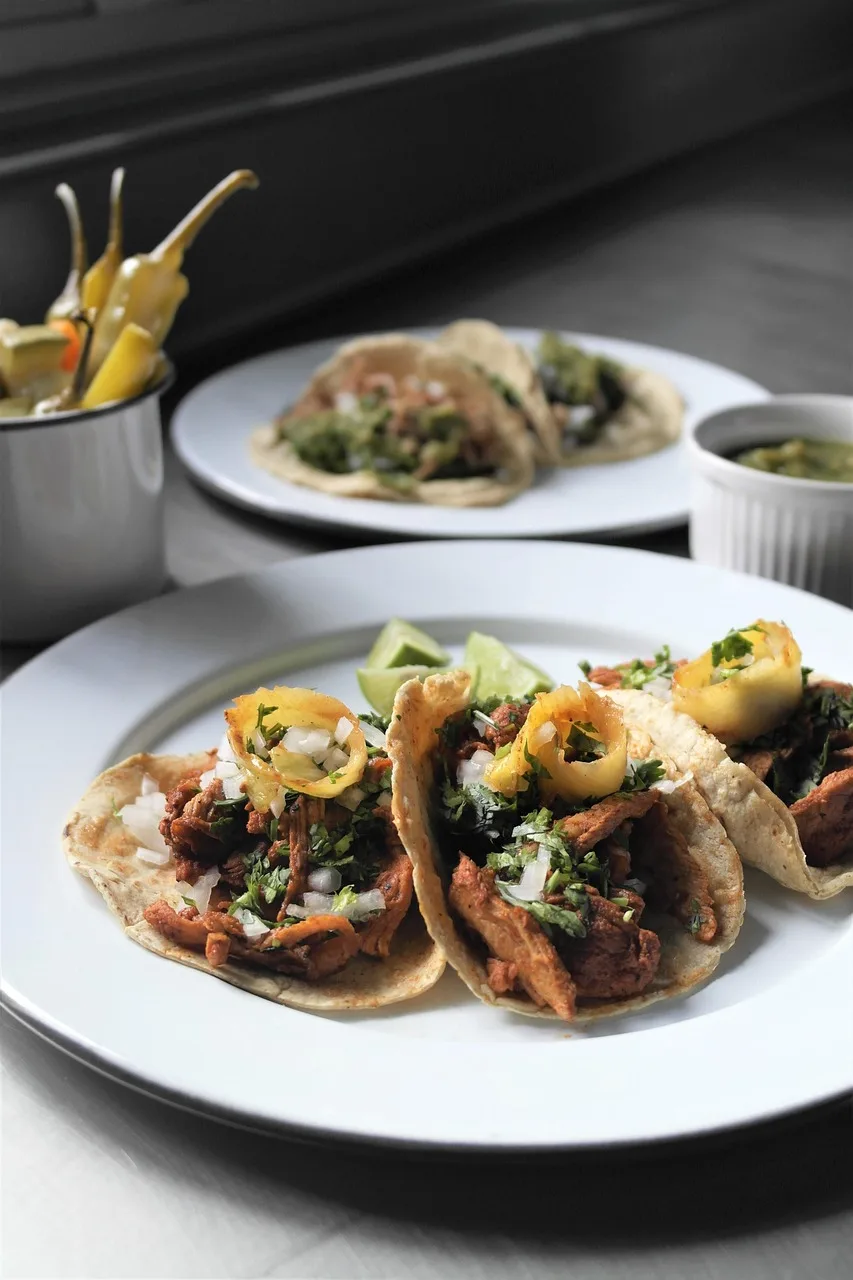
Tacos Hola El Güero at Amsterdam 135 has been open since 1968 and does tacos de guisado: stews held hot in big ceramic pots, ordered at the counter, with a handful of small tables outside. You choose one tortilla or two and you point. The picadillo is the standout, and the vegetarian pots here are not an afterthought but a substantial part of the lineup. This is a lunch operation, not a dinner one.
The other is Expendio de Maíz on Avenida Yucatán 84 in Roma Norte, and it is the purest expression of the argument this article is making. Four communal tables. No sign. No menu. Cash or bank transfer, and nothing else. Reservations are not accepted at all, so there is nothing to book even if you wanted to. You sit, they ask how hungry you are and whether you have allergies, and then the kitchen cooks until you tell it to stop. The corn is heirloom, nixtamalised and milled inside the building, and it turns into tortillas, sopes and huaraches made to order and dressed in whatever is in season. The waitlist gets long fast. Put your name down, then walk the Álvaro Obregón median for half an hour and come back. One hard constraint, on the stop that is supposed to have none: it is closed on Mondays.
Late afternoon: nieve, then churros
Nevería Roxy opened in Colonia Condesa in 1946, and it opened as a soda fountain rather than an ice cream shop, which explains why the room still feels like a counter you are meant to sit at. The recipes trace back to Carlos Gallardo, who as a boy in La Barca, Jalisco, bought a white lime nieve he spent his adult life trying to reproduce, and who first sold his versions in the portico of the Cine Roxy in Guadalajara. His wife, María Luisa Rubio, made the nieves and jams. The original Condesa branch is on Fernando Montes de Oca 89; there is a second on Tamaulipas 161, at the same intersection as the chilaquil stand. Order a nieve, which is the water-based one, not a helado, and order lime.
Then churros. Churrería El Moro has been making them since 1935 from a recipe its founder brought from Spain, fried in a batter the company says contains no ingredient of animal origin, and served with a thick hot chocolate made from Tabasco cacao. There are branches at Michoacán 27 in Hipódromo Condesa and Frontera 122 in Roma Norte, both running until eleven at night every day, and the original on Eje Central keeps going around the clock, which tells you what churros are actually for.
After midnight: the trompo
The neighbourhood's late anchor is El Tizoncito on Avenida Tamaulipas 122, where the al pastor comes off a vertical spit and the kitchen stays open past three in the morning on weeknights and until five on Fridays and Saturdays, according to the chain's own branch listing. Order pastor, ask for it con todo, and accept the pineapple.
The one thing to book
Contramar, at Durango 200 in Roma Norte, has been open since 1998 under Gabriela Cámara, and it is the one place on this list where you should book. It is a lunch restaurant in the Mexico City sense, meaning the room peaks in the afternoon rather than at night and the doors close at eight in the evening. Worth knowing in advance, so that you do not walk up at two on a Saturday and discover the seating situation personally. The tuna tostada with chipotle mayonnaise and the pescado a la talla, split and painted red on one side and green on the other, are what people go for.
Everything else above takes you as you are. The variable is not whether they will have you. It is whether you arrived in the right two hours.
Sources
- Avenida Amsterdam, Mexico City tourism office - the quoted line about the racetrack determining the street layout; the elliptical avenue, José Luis Cuevas and Lomas de Chapultepec, and the walkable medians on Mazatlán, Durango, Alfonso Reyes and Veracruz
- Parque México, Mexico City tourism office - Cuevas laid the park out in 1925, it opened in 1927, and he had designed Parque España in 1921
- Parque México, Wikipedia - the park was developed on the former site of the Jockey Club de México horse race track
- Colonia Roma, Mexico City tourism office - Roma built in 1903 on fields of the old village of La Romita; the planted central walkway on Álvaro Obregón
- Mercado Medellín, Mexico City tourism office - official name Mercado Melchor Ocampo, Campeche 101, over 500 vendors, Cuban, Colombian, Peruvian and Venezuelan sellers after the 1985 earthquake, La Morenita de Medellín
- Mercado Medellín, Wikipedia - the Little Havana nickname and the Colombian and Cuban flags over the stalls
- Mercado Roma, Wikipedia - a gourmet food hall on Querétaro street in Roma Norte by Rojkind Arquitectos, with stalls from restaurants known outside the market and a rooftop beer garden
- Michoacán Market, Wikipedia - built 1946, functionalist, the only market serving the three Condesa colonias, the Saner and Sam Flores murals painted in 2008
- Rehabilitación del mercado Michoacán y su entorno, Gustavo Ahuactzin Larios, UDLAP, 2004 - the building survey giving 360 square metres and 27 stalls
- Demanda el Inbal a la Cuauhtémoc devolver fachada original a mercado de la Condesa, La Jornada, 4 January 2023 - INBAL found the borough's works had substantially altered the original facade, ordered the added metalwork and polystyrene cornice removed, and recorded that the facade had been painted white over the red and yellow
- Panadería Rosetta, contact and location - Colima 179, Roma Norte, opening at 7:00 Monday to Saturday and 7:30 on Sundays
- Panadería Rosetta, menu - rol de guayaba at 140 g, concha and puerquito de piloncillo under pan dulce, pan de pulque under the sourdough loaves, café de olla
- Dónde está la esquina del chilaquil en la CDMX, El Universal - the corner of Alfonso Reyes and Tamaulipas, morning hours, and the account attributed to Perla of why the torta was invented
- La Esquina del Chilaquil, Time Out México - the queue at Tamaulipas and Alfonso Reyes, the milanesa classic and the cochinita version
- Tacos Hola El Güero, MICHELIN Guide - Ámsterdam 135, open since 1968, guisado tacos in ceramic pots, counter service, picadillo
- Expendio de Maíz, visit page - Av. Yucatán 84, closed Mondays, no reservations taken, payment in cash or bank transfer only
- Expendio de Maíz, MICHELIN Guide - four communal tables, no sign, no menu, corn nixtamalised in house into tortillas, sopes and huaraches
- Nevería Roxy, history - founded in Condesa in 1946 as a soda fountain, the Cine Roxy and La Barca origins, Carlos Gallardo and María Luisa Rubio
- Nevería Roxy, branches - the first at Fernando Montes de Oca 89 and the second at Tamaulipas 161
- Churrería El Moro, home page - Francisco Iriarte brought the recipe from Spain and opened El Moro in 1935; the churros carry no ingredient of animal origin; the chocolate is made with Tabasco cacao
- Churrería El Moro, branches - Michoacán 27 and Frontera 122 open 9am to 11pm daily, and the Eje Central Lázaro Cárdenas 42 original open 24 hours
- El Tizoncito, branch listing - Avenida Tamaulipas 122 in Condesa and its early-morning closing times
- Contramar, reservations and hours - Durango 200, Roma Norte, service to 20:00 daily, reservation lines open 10:00 to 20:00
- Contramar, MICHELIN Guide - open since 1998 under Gabriela Cámara, tuna tostada and pescado a la talla