Crossing the Road in Hanoi Is a Skill, and Hesitating Is the Mistake
LineCast Networks

In December 2006 Seymour Papert stepped into a Hanoi street and a motor scooter hit him. MIT, where he spent his career, records it without ornament. He was in the country for a mathematics education conference, and he "suffered a serious brain injury when struck by a motor scooter in Hanoi." He was 78. A VOA correspondent in the city filled in the scene a week later: Papert was crossing a six-lane road between his hotel and the National University of Technology when a speeding motorbike hit him, and he had lain unconscious in a Hanoi hospital since 5 December. He came out of the coma. Writing in VnExpress in 2025, the businessman Dinh Hong Ky records what followed as "severe aftereffects" and a decade of health complications before Papert died in 2016.
Papert is the reason a generation of schoolchildren made a triangular turtle draw a square on a screen. He also spent his working life on the question of how simple local rules produce complicated global behaviour, which happens to be a serviceable one-line description of Hanoi traffic. Walking beside him was Uri Wilensky, the computer scientist behind NetLogo, a platform built for modelling exactly that sort of system. Wilensky told VOA the two of them had been working out what rules might generate the patterns they were watching, and that it would have made a good demonstration to close the conference with, since the traffic had everyone rattled. Dinh's commentary puts the same moment more bluntly: they were picking their way across an unsignalled junction, dodging bikes, when a rider came through fast.
Start there, because the received version of this city goes the other way. In the received version the traffic is a benign swarm, the crossing technique is a party trick, and the only thing standing between you and the far kerb is nerve. The technique is real. Papert had every intellectual tool needed to understand the system and it still put him in a coma. What follows is the mechanism, the law, and the specific places where the mechanism fails.
The law is not silent, and it is not what you assume
The statute now governing all of this carries the title "Law on Road Traffic Order and Safety, No. 36/2024/QH15," and it took effect at the start of 2025. Article 30 sets out what pedestrians must do, and it is more accommodating than the folklore suggests. Pedestrians walk on pavements or, where there are none, hug the right-hand margin of the carriageway. They cross at signals, markings, footbridges or underpasses. And then the clause everyone should know, in the English translation available: where none of those exist, pedestrians "shall observe oncoming vehicles, and may only cross the road with hand signals when finding it safe."
Hand signals. The Vietnamese legislature wrote the mid-block crossing into statute and asked you to raise your hand while doing it. The tourist who walks out flat-palmed into Hàng Bạc is not defying the rules. She is, roughly, complying with them.
Article 11 handles the lights, and here the assumption most visitors import is wrong in a way that matters. Green means proceed, and where pedestrians are on the carriageway, drivers must slow or stop to give way. Flashing amber allows traffic to proceed but again requires drivers to slow or stop for people crossing. Red means stop. Full stop, with no clause carving out a right turn. In January 2025 traffic in Ho Chi Minh City seized up at peak hours precisely because riders stopped turning right on red at junctions lacking a supplementary sign permitting it, and the Ministry of Public Security's Traffic Police Department said any proposal to allow the manoeuvre generally would need thorough research first.
So the green man in Hanoi is worth more than the green man in Los Angeles, in principle. But read the junction before you trust it. The traffic police list three ways a vehicle may legally cross your phase on a red: a supplementary sign, a green arrow light, or an officer on duty waving it through. And that last one outranks everything, because Article 11 puts the commands of a traffic guard at the top of its order of priority, above the lights themselves. A policeman with his right arm raised forward beats your green man, and the law expects you to walk behind him.
In practice, the British Foreign Office puts it in five words: "Compliance with road laws is poor." Decree 168/2024, in force since 1 January 2025, raised the penalties sharply, including for failing to give way to people on foot: one to two million dong for a rider, four to six million for a driver. Decree 238/2026 amended that text from 15 August 2026, but the traffic police held throughout the drafting that the tariffs would not rise, and they did not. A Vietnamese commentator writing shortly after Decree 168 landed observed that many drivers still treat yielding as a courtesy rather than an obligation.
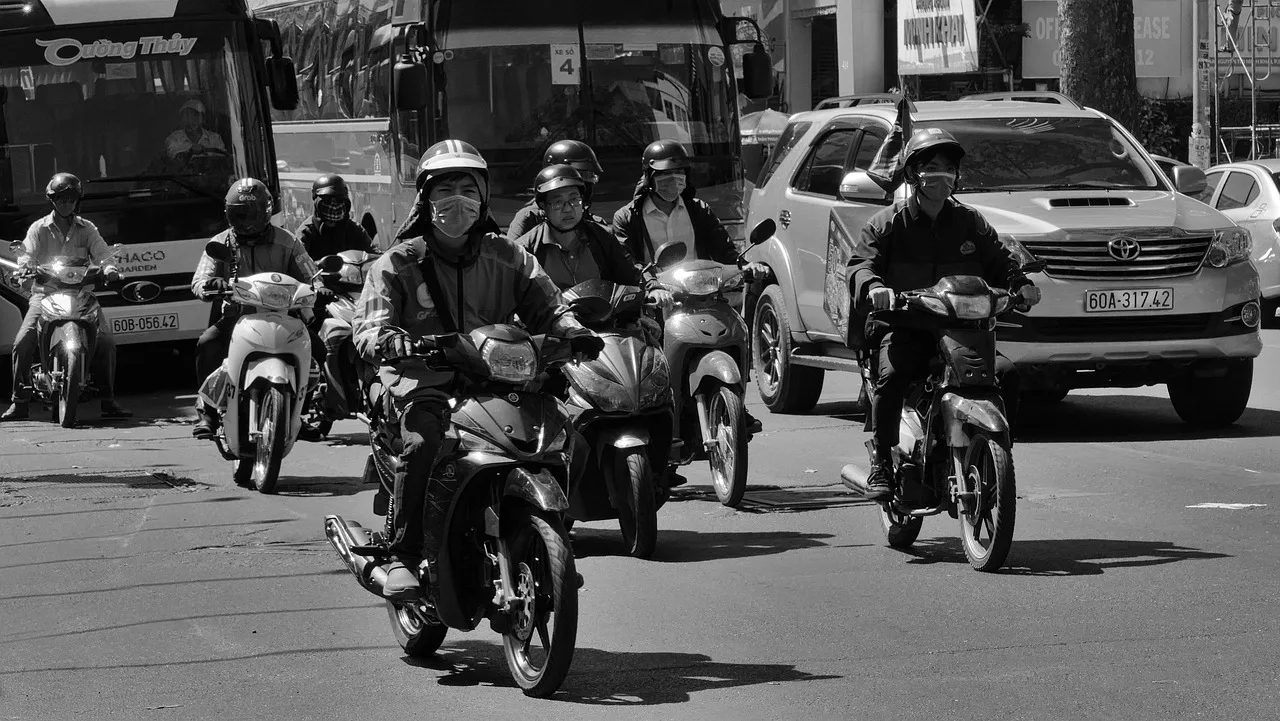
Why the flow behaves the way it does
The mechanism is arithmetic. By the count of the Hanoi People's Council's Urban Affairs Committee, published in May 2026, the city holds more than eight million private vehicles: 6.9 million motorbikes on top of 1.1 million cars. Over 450,000 of those motorbikes operate inside Ring Road 1, the historic core. Nationally, the National Traffic Safety Committee's deputy chief put registered motorcycles at 77 million at the end of 2024, and reckoned that in Hanoi and Ho Chi Minh City buses and trains between them carry only 10 to 15 per cent of the demand for travel.
A motorbike, call it half a metre wide for the sake of the picture, can change its line inside its own length. A stream made of them is not a stream of vehicles so much as a stream of individually steered points, each of which is continuously solving a small problem: where will the gaps be one second from now. When you step off the kerb at a steady pace, you become a soluble term in every rider's calculation. The way it looks from the road is that they aim at the space you will have vacated, and that the manoeuvre costs them a few centimetres of handlebar. That is an explanation rather than a measured finding.
Stop, and you delete the term. Step back, and you replace it with a different one, at the exact moment the rider has committed to the first. That is the whole of it. The instruction is not "be brave." The instruction is "be predictable," and hesitation is the one thing that makes you unpredictable.
The technique, stated honestly
Walk out at the pace of a slow stroll. Hold it. Look at the riders, not at the road surface and not at your phone, because eye contact is the confirmation that they have seen you and you have seen them. Raise a hand, palm out, at chest height, which is both the legal signal and a visible one. Do not run. Do not stop mid-lane unless a gap in front of you closes hard, in which case pause where you are rather than reversing, because the traffic behind has already routed around your current position. Cross where you can be seen from a distance, not from behind a parked lorry or a bus.
None of that paragraph is law or research. It is practitioner habit, and the only part with a statute behind it is the raised hand. If this is your first hour in the city, wait and go across alongside somebody local. It is not cowardice, it is calibration, and it works better than any written description including this one.

Where the mechanism genuinely fails
The technique assumes a vehicle that can steer around you. Several things break that assumption.
Cars, buses and lorries have a fixed tracking width and a stopping distance measured in car lengths. On a two-lane street in the Old Quarter this rarely matters because nothing is moving fast. On a multi-lane arterial or a ring road it matters entirely, and the constant-pace approach is simply the wrong tool. Use the signalled crossing, the footbridge or the underpass. Article 30 is not being decorative when it lists them first.
Speed breaks the model everywhere. The reason the flow parts around you at twenty kilometres an hour is that riders have time to re-plan. At fifty they do not. Papert was hit by a bike the VOA report describes as speeding, on six lanes, and he was walking with the one person alive best equipped to model the alternative. Judge the speed before you judge the gap.
And the pavement is not a sanctuary. Australia's Smartraveller advice tells travellers to "stay alert to motorcycles approaching from behind as you walk on the footpath." Read in context, that is a bag-snatching warning: it sits in the petty crime section, under a line about thieves on motorbikes robbing people on foot. The habit is worth more than the reason given for it. Riders also treat pavements as an overflow lane when the road jams, which is an observation of mine rather than a government warning. Either way, walking in Hanoi means keeping half an ear behind you even when you are not in the road.
There is one place in the city where the standing-still-and-being-flowed-around instinct is actively lethal, and that is the railway lane between Hanoi Station and Long Biên. Trains do not steer. Cafés along the tracks on Lê Duẩn, Khâm Thiên, Trần Phú and Phùng Hưng have drawn crowds since 2018. The city banned the visits and put fixed barriers across the Trần Phú entrance, and VnExpress reports that thousands a day walk in anyway, for the sake of watching a train pass a wall with about a metre to spare. A March 2026 letter from the Ministry of Construction to the city agreed to thin the rail traffic out: no more freight on the section, fewer passenger services. Until that is done, the tracks are live.
What happens if something goes wrong
This is the part worth reading twice, because it is the same in both directions. Both the British and Australian governments warn that anyone caught up in a road accident in Vietnam can face criminal charges and a bill for the other party's injuries. Their qualifiers differ, and you want both. Smartraveller's is about blame: you could be charged, and that is "regardless of who's at fault." The Foreign Office's is about scale: you may have to pay compensation "even if the injuries are minor," and it adds that there is "the possibility of a travel ban while the investigation is carried out." That is the legal environment you are walking into, not just riding into.
On riding, the answer differs by nationality and you cannot take one country's version as general. The Foreign Office tells British nationals they need both a 1968-format international driving permit and their UK licence to drive a car or motorbike in Vietnam. Smartraveller tells Australians the opposite: neither an Australian licence nor an Australian-issued IDP is accepted, and a temporary Vietnamese licence, which requires a residence permit held for at least three months, is the only lawful route.
The gap is a treaty artefact. Vietnam ratified the 1968 Vienna Convention on Road Traffic and has issued permits under it since November 2015, and the 1968 format is what Vietnamese practice recognises. Australia is party to the older 1949 Geneva Convention, and the Australian Automobile Association issues that format on the government's behalf, which is why an Australian permit does not travel this particular border. Check your own government's current advice rather than a hire shop's assurance, and note that riding without a valid licence will usually void your travel insurance as well. Smartraveller says so in as many words.
Scale, for context: the World Health Organization's Global Health Observatory puts Viet Nam's estimated road traffic death rate at 17.7 per 100,000 people for 2021. Vietnamese transport researchers reported in early 2025 that motorcycles are involved in 65 to 70 per cent of crashes and that more than 90 per cent of road deaths are motorcycle-related.

The city is rebuilding itself around the problem
On 1 July 2026 Hanoi began piloting a low-emission zone inside Ring Road 1. Nine central wards are the scheme's eventual footprint, not its opening one; that arrives in the third phase, across 2028 and 2029. Anyone reading older coverage should discard it for a different reason too: the Prime Minister's Directive 20 of July 2025 called for a full ban on fossil-fuel motorcycles inside Ring Road 1 by mid-2026, and that plan was replaced in November 2025 by a People's Council resolution setting time-based and area-based restrictions instead. Government News, the state portal, says the softer approach reflects feedback about infrastructure capacity and travel habits.
The first phase runs to the end of December 2026 and is confined to the core of Hoàn Kiếm ward. The zone is bounded by eleven Old Quarter streets, among them Tràng Tiền, Hàng Đào, Hàng Ngang, Hàng Buồm, Mã Mây and Lý Thái Tổ, covering about half a square kilometre and roughly 20,000 residents. As announced, petrol motorcycles and mopeds are shut out of it from 6pm to midnight on Friday, then from 6am to midnight on Saturday and again on Sunday, though reported accounts of the phase-one hours differ in detail and how tightly any of it is being enforced is not yet clear. App-based ride-hailing bikes running on fossil fuel are excluded outright. Plan around the footprint you can actually see: a walker in Ba Đình or Tây Hồ is in the scheme's future, not its present.
The sweetener is smaller than the headlines make it sound. Bus fares are waived, as announced, for a year from 1 July 2026 to 30 June 2027, on public services but not on tourist ones, and the qualifier is geographic: the exemption is for passengers travelling out of the Ring Road 1 area. Hanoi People's Committee announced it on 15 June 2026 and said plainly that making the whole network free at once would have been too heavy a load on the budget. The metro is thinner than it looks as well. Line 2A runs to Hà Đông. Line 3 carries passengers from Nhổn only as far as Cầu Giấy, on the 8.5 km elevated stretch that opened in August 2024. The 4 km underground extension on to the main railway station is still a building site: Railway Gazette reported this August that it is "in the delivery phase for opening in 2027." Nobody is riding it into the Old Quarter this year.
For a person on foot the restricted hours are still the most consequential change in decades. On a Saturday afternoon in the core of the Old Quarter, the mechanism described above is temporarily beside the point. There is nothing to read.
Saigon, and everywhere else the mix holds
Law 36/2024 is national. Article 30 applies in Ho Chi Minh City exactly as it applies in Hanoi, and so does the arithmetic: 77 million motorcycles is a country-wide figure, not a Hanoi one. The reading transfers to Saigon, to Da Nang, to Huế.
What changes is margin. Saigon's boulevards are wider, the crossings longer, and a longer crossing means more seconds during which somebody can misjudge you. That is a walker's impression rather than a measurement, but the correction it implies is cheap. The correct adjustment is not more nerve. It is a stricter preference for signalled crossings on the big roads and the same steady pace on the small ones.
The thing the swarm story gets wrong is the direction of the agency. The flow does not part for you out of collective courtesy. Several hundred individual riders each make a small correction because you have given them enough information to make it cheaply, and they stop making it the moment you stop being legible. Papert would have found that a decent description of an emergent system, and he would have pointed out that emergent systems have no obligation to include you.
Sources
- Law on Road Traffic Order and Safety 2024, No. 36/2024/QH15 (LuatVietnam English translation) for Article 11 on signals and the order of priority that puts a traffic guard above the lights, and Article 30 on pedestrians and the hand-signal crossing.
- Seymour Papert, pioneer of constructionist learning, dies, MIT News, 1 August 2016.
- Computer Guru's Accident Highlights Vietnam's Traffic Woes, Matt Steinglass, VOA, December 2006, for the six-lane road, the speeding motorbike, the coma from 5 December, and Uri Wilensky's account of what they were discussing.
- Making roads safer for pedestrians in Vietnam, Dinh Hong Ky, VnExpress, 10 February 2025, for the aftereffects and the decade of complications, the unsignalled junction, the Decree 168 pedestrian give-way fines, and drivers treating yielding as optional.
- Vietnam travel advice: safety and security, UK FCDO, for poor compliance with road laws, criminal charges and compensation "even if the injuries are minor", the travel-ban warning, and the 1968-format permit requirement for British drivers.
- Vietnam travel advice, Australian Smartraveller, for the footpath warning in its petty crime section, criminal charges "regardless of who's at fault", the non-acceptance of Australian licences and IDPs, the three-month residence permit condition, and the insurance consequence of riding unlicensed.
- Turning right on a red light requires research: traffic police, Viet Nam News, 13 January 2025, for the HCMC congestion and the three lawful exceptions on a red.
- Stricter fines for traffic violations introduced under new decree, VietnamPlus, for Decree 168/2024 taking effect on 1 January 2025.
- Amending Decree 168/2024: cutting procedures, not raising penalties, Chinhphu.vn, for Decree 238/2026 leaving fine levels unchanged.
- 90% of traffic deaths caused by motorcycle accidents, VietNamNet, for 77 million registered motorcycles at end-2024, the crash and fatality shares, and the public transport share of travel demand.
- Hanoi reveals motorcycle numbers in inner city areas, DTiNews, May 2026, for the vehicle counts and the figure inside Ring Road 1.
- Ha Noi to pilot low-emission zones in nine inner-city wards from this July, Government News (VGP), for the scheme's eventual nine-ward footprint and the rationale for time-based limits.
- Hanoi to pilot petrol motorbike ban in Old Quarter from July, VietnamPlus, for phase one's dates, the eleven streets, the area and population, and the restricted hours.
- Hanoi proposes phased restrictions on fossil fuel vehicles in low-emission zone plan, VnEconomy, for the phase two and phase three timetable.
- Hanoi to ban gasoline motorbikes during specific hours starting July 2026, VnExpress, for the November 2025 resolution replacing Directive 20's full ban.
- Hanoi offers free bus travel for Ring Road 1 residents, DTiNews, 15 June 2026, for the one-year fare waiver, its geography, the tourist-service exclusion and the budget reasoning.
- Vietnam: ambitious metro expansion targets lie just out of reach, Railway Gazette International, 8 August 2026, for the 8.5 km Nhổn to Cầu Giấy section opening in August 2024 and the 4 km underground extension to Hanoi's main station being in delivery for 2027.
- Hanoi moves to end train services through its world-famous railway coffee street, VnExpress, for the March 2026 agreement, the café streets and the crowds.
- VN officially issues International Driving Permit, Government News (VGP), 4 November 2015, for Vietnam's ratification of the 1968 Vienna Convention and the permits issued under it.
- International Driving Permits, Australian Automobile Association, for Australia's 1949 Geneva Convention basis and the AAA's authority to issue.
- Estimated road traffic death rate (per 100,000 population), WHO Global Health Observatory, for the 2021 figure of 17.7 for Viet Nam.