Bo-Kaap Is a Neighbourhood Where People Live, Not a Colour Palette
LineCast Networks
For roughly forty years, the museum at 71 Wale Street told visitors it had been the home of Abu Bakr Effendi, the Ottoman scholar sent out to the Cape in 1862. Iziko Museums, which runs the building, now states plainly that this was wrong. The house belonged to a different branch of the family: Mahmud Fakih Emin Effendi, appointed the second official Ottoman scholar at the Cape in 1894, and after him his son, Muhammed Dervish Effendi. The Effendis were forcibly removed in the late 1970s. When Muhammed Dervish's widow, Mariam, was evicted along with her children and grandchildren, "every trace of their lives was removed from the house", in the museum's own words. In 1978 it opened as the Bo-Kaap Museum.
Iziko put that correction on the wall, in an exhibition it titled "The Effendis of 71 Wale Street, Bo-Kaap", drawing on archival research by Halim Gençoğlu at the University of Cape Town and on photographs and objects lent by the family. Go and read it. Not because of what it says about one address, but because it lays out, inside a house taken from a family in order to explain that family's culture to strangers, the exact mechanism by which a place where people live turns into a place that represents them.
That is the problem with the Bo-Kaap, and it is worth stating before any advice about where to eat.
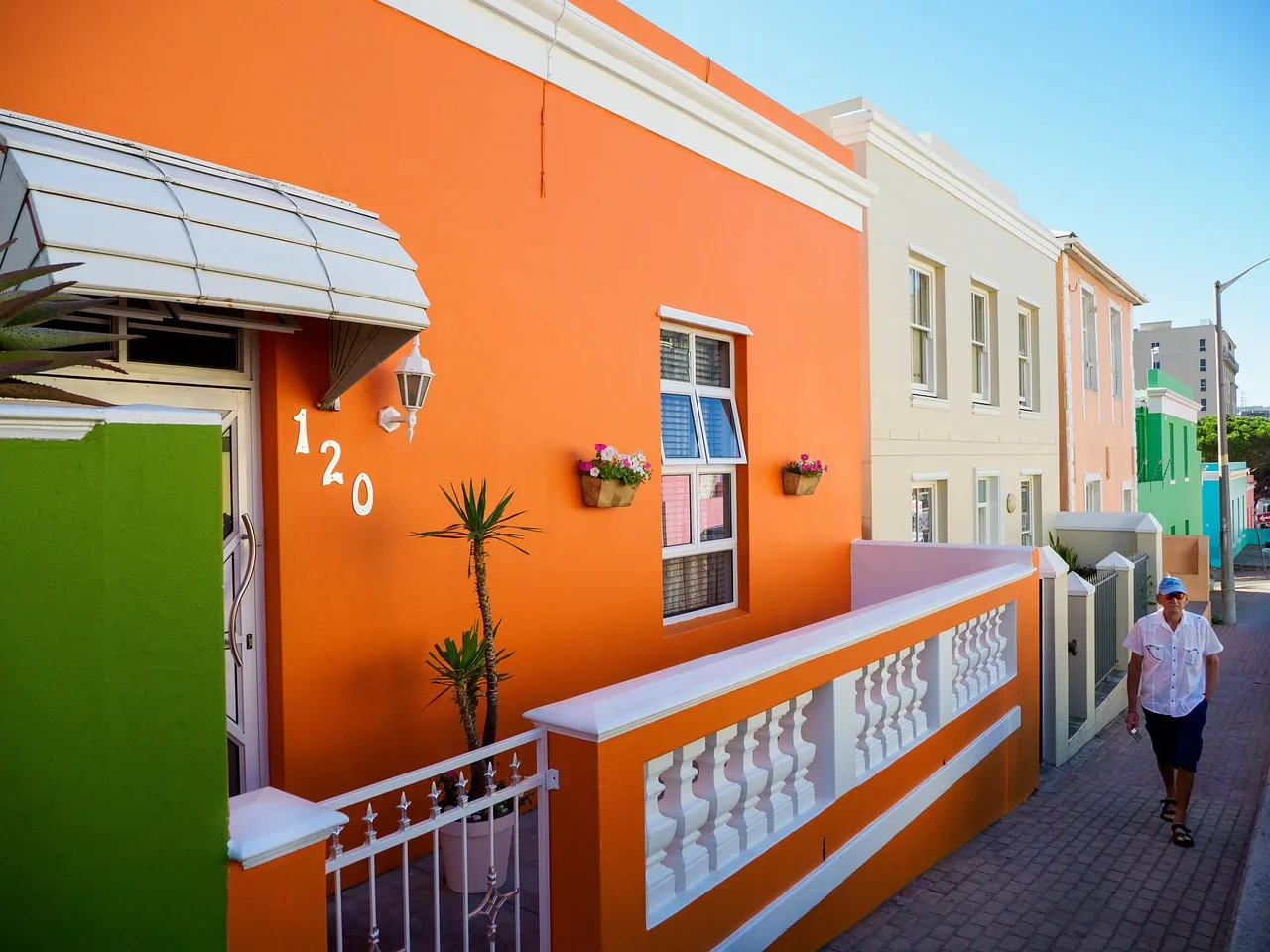
The colours are a live decision, not a heritage feature
The received version goes like this: the houses had to be white while they were rented, and when residents were finally able to buy them, they painted them in bright colours as an expression of freedom. Cape Town's official tourism organisation prints it, with a tell: "the choice of colour is said to be attributed to". Nobody I can find pins it to a document. It is a good story and it may well be true, and it is repeated with a confidence the evidence does not carry.
What is documented is less romantic and more useful. Most of the Bo-Kaap's houses are huurhuisjes, hire houses, single-storey and flat-roofed, put up as speculative rental stock from the 1760s onwards and let to immigrant artisans, free blacks and freed slaves. The museum is one of them: Iziko says it is the only house Jan de Waal built that still holds its original form, and dates the building to 1768. The City of Cape Town's heritage assessment says the type has largely fallen to development pressure in the central business district, leaving the Bo-Kaap as the last coherent collection of that residential landscape.
And the paint, legally, is not heritage at all. Cape Town's Full Council voted the neighbourhood into a Heritage Protection Overlay Zone in March 2019, after roughly four years of pressure from residents; the area covered sits at the foot of Signal Hill, bounded by Buitengracht, Strand and Military Road. What the overlay does not govern is colour. A city-wide schedule of exemptions, approved by Council in January 2016 and applying to any site protected under an overlay's general provisions, releases owners from having to obtain the City's approval for, in the schedule's wording, "Re-painting or re-decorating (including changes in paint colour but not including painting of natural stone, unpainted metal, face-brick, ceramic, or unpainted wood, or similar such unpainted surface)". The bracket carries a limit worth knowing, then: colour is free on a surface that was already painted, not on bare stone, brick or timber. You need permission to replace your windows. You need none to take an already-painted façade from lime green to cobalt on a Saturday. The palette in the photographs is a choice residents make and remake, which is precisely why it should not be treated as scenery.
While we are on names: the City's heritage document records, in a footnote, that the official change of name to Bo-Kaap happened in 2016. The maps used to say Schotschekloof, and before that the Malay Quarter. Iziko is blunt about where the labelling came from, writing that "the idea of a Cape Malay culture was actively promoted by the Nationalist Party government", and noting that the apartheid state's category of Malay was not a synonym for Muslim at all, since it left out South African Indians who had arrived later. Both terms are still in circulation. The Heritage Portal writes Cape Malay; Iziko's own text about the neighbourhood mostly says Cape Muslim. Listen to which one your guide uses and use that.
The stoep is a room with no door
The City's own heritage document is unexpectedly sharp about why this neighbourhood feels different from the rest of the inner city. The houses and yards are small, so, in its words, "much socialisation happens in the public interface: the stoeps and the sidewalks". It then notes something that reads almost like relief: the Bo-Kaap is "a rare example of an inner city neighbourhood where the residents have not retreated behind high security walls".
In a city that has largely surrendered to electric fencing, the Bo-Kaap still has the stoep. The same document describes it as a raised platform traditionally running the length of a house's façade, sometimes with seats built into the ends, and calls it "the physical expression of an ethos of neighbourliness (the culture of Kanala)". A room with no door, occupied by children, grandmothers, tea and gossip, at street level, in front of you.
Which settles most of the etiquette questions in one go. A camera pointed at a stoep is a camera pointed into a living room. So:
Streetscapes are the part nobody has to negotiate. Cape Town Tourism is explicit that no permit is needed to walk the Bo-Kaap and the surrounding city-centre streets, and a photograph of a terrace is not generally treated as an intrusion. People are a different matter and require asking, in words, before the shutter. Never shoot through a window or an open front door. Do not sit or pose on a doorstep that is not yours, and do not arrange your friends across someone's steps for a group shot. Where a house displays a sign asking you not to photograph it, that is not a suggestion, and it is the clearest statement you will get of where one household draws its line. And stay out of the roadway: the streets are narrow, cobbled, full of children and older people on foot, and used by commuters as a shortcut around the Buitengracht traffic, a combination the City itself flags as a safety risk to pedestrians and residents.
There is a longer history behind the coolness you may get. In 2022 residents told the Weekend Argus that film crews were monopolising the neighbourhood's scarce parking, and one resident objected to a gangster scene being shot outside a mosque in Leeuwen Street. A community leader described the effect as "the terrorist ruffian stereotyping of Muslims". The City replied that its film office was not aware of permitting any shoot that framed Bo-Kaap Muslims as terrorists, and its spokesperson put the office's tally for the year so far at over 2,800 permits issued citywide. Take the residents' point anyway. Someone who reacts flatly to your lens has a considerably longer relationship with lenses than you do.
What is actually worth going inside
The museum first. It is small, it takes under an hour, and the building is the exhibit as much as the contents: the curved Baroque parapet on the façade, the sash windows with teak shutters, the boenonder door whose upper glazed panel slides down to let light into the hall, the flat roof once waterproofed with a mopped mixture of whale oil and molasses. Iziko has free entry on commemorative days, so if you are in Cape Town on one of them, that is the morning to go.
Then the mosques, and specifically the fact that the neighbourhood's oldest sacred sites are quarries. The Dutch East India Company permitted no public worship outside the Reformed church, so Cape Muslims gathered and prayed in the disused quarries along the Strand Street side, a practice the City's assessment says continued well into the nineteenth century. Two of them, the Prayer Quarry and the Wash House Quarry, are on the national heritage register today for exactly that reason.
The Auwal Masjid on Dorp Street is the oldest mosque in South Africa. Its founding date moves around depending on who is counting, from the mosque's own 1794 to Iziko's 1798 to the 1804 recognition below, but the land is fixed: bought in September 1794 by Coridon van Ceylon, a freed Black Muslim and the first Muslim property owner in Cape Town. The properties passed on his death to his wife, Trijn van de Kaap, who sold them in 1809 to her daughter, Saartjie van die Kaap; it was Saartjie who made the site available for the building. Its first imam was Tuan Guru, Imam Abdullah Kadi Abdus Salaam, a prince from Tidore exiled to the Cape and imprisoned on Robben Island, who wrote out copies of the Qur'an from memory and founded the mosque that shaped Cape Muslim religious life. Religious freedom was not proclaimed at the Cape until 25 July 1804, under an ordinance from Commissioner de Mist, a full decade after Coridon bought the ground. Separately, the City's assessment, following the historian Achmat Davids, notes that the Auwal was only recognised as a mosque in that same year, 1804. It is a working congregation, not an attraction with a ticket desk. If you want to see inside, write to them or go with a guide who has a relationship there, and dress for it.
Above the houses, at the top of Longmarket Street with its entrance off Dawes Street, is the Tana Baru, which the City's heritage document calls "the oldest officially granted Muslim burial ground in South Africa". It is not one ground but three lying adjacent to each other: two on land granted to the Cape Muslim community in 1805 and in 1842, the third made up of private plots that prominent imams bought in trust for their congregations. Tuan Guru is buried here, described by the Heritage Portal as the first Chief Imam at the Cape, in a mausoleum of modern face brick just behind the gateway. Close by is the whitewashed mausoleum of Tuan Said Alawie, whom the same account calls "the first official Imam of the Muslim community". A third grave belongs to Paay Schaapie, also known as Tuan Nuruman, banished from Batavia to the Cape in 1770 and later a freed slave living in the Slave Lodge, remembered for his fondness for children and animals and for the well he dug nearby to water them; his grave is plain by his own instruction, and he asked that no wall ever enclose it. Abu Bakr Effendi is buried near the top end of the ground, his grave signposted, which is a strange rhyme with the museum below.
In February 1886 the colonial authorities closed the Tana Baru under the Public Health Act, rejecting the community's argument that its graves, dug five to six feet into the hillside, posed less risk than the shallow vaults of the town's other cemeteries. Two days later the child of Amaldien Rhode, a Muslim fisherman from Woodstock, died. Three thousand people marched from Woodstock and buried the child there anyway. Rioting broke out after the burial, and the disruption ran on across Cape Town for three days. The Tana Baru Trust that now cares for the site grew out of a preservation committee formed in 1978, after Imam Abdurahman Bassier of the Boorhaanol mosque witnessed the cemetery being desecrated, and it drew on the archival work of Achmat Davids to prove the full extent of the burial ground.
Visit it properly or not at all. The Heritage Portal's visiting notes put it plainly: the kramats are sacred sites, so appropriate attire is required. As at any kramat, shoes come off at the shrine. Do not sit on, lean against or step over a grave. Keep your voice down. And in case this needs saying, one heritage writer records that the caretaker told him of a hotel employee who once had to stop an overseas visitor walking off the site with a hand-engraved tombstone.
Nineteen sites in the neighbourhood were declared national heritage sites in the Government Gazette in 2019: the museum, the Auwal, the Tana Baru, five more mosques, Schotsche Kloof and St Paul's primary schools, Vista High School on Military Road, the Schotsche Kloof and Stadzicht homesteads, Spolander House on Dorp Street, the stables on Rose Street, three quarries and a stone wall along Buitengracht.
Where to put your money
A cooking class is the highest-value thing on offer here, and not for the food, though the food is the point. You spend two or three hours in a household kitchen with your hands in dough, and the fee lands in a Bo-Kaap home rather than a coach company. Cape Town Tourism's guide points to three: the Bo-Kaap Cooking Tour, Faeeza's Home Kitchen and Cape Fusion Tours. The first has run from 46 Rose Street since 2004, founded by the cook Zainie Misbach, though later write-ups describe a younger generation of the family teaching, so ask who is teaching when you book. Book direct.
For an hour on foot without a group, VoiceMap sells a self-guided audio walk narrated by Shereen Habib, who by her own account has guided for more than twenty years and whose family has lived in the Bo-Kaap for close to a century. It covers about a kilometre and 28 stops in roughly an hour. It has the enormous advantage of putting a resident's voice in your ear while you look at her street.
Buy spice at Atlas Trading on Wale Street, in business since 1946 and still family-run, and take home masala rather than a fridge magnet. For eating, Bo-Kaap Kombuis on August Street and Biesmiellah at Wale and Pentz are both long-established family restaurants. At Rose Corner Café, order a koesister and note that this is not the syrup-drenched plaited koeksister sold elsewhere in South Africa but the round, spiced, coconut-rolled Cape Malay version, which is a different thing entirely and better at breakfast.
Which streets to leave alone
There is no official list, so use a rule instead. If a street has no shop, no restaurant, no mosque you have been invited into and no signage, you are standing in someone's front garden. The commercial spine is Wale Street, and the surrounding blocks between Wale and Longmarket carry most of what visitors come for. The upper slopes and the Schotsche Kloof flats, a late-1930s addition to the neighbourhood, are housing, full stop, and offer a photographer nothing that the lower streets do not.
Understand also that the neighbourhood is under real pressure and is not of one mind about it. The City's heritage document names the threat in flat planning language: high demand for properties close to the central business district, "the alienation of many of the properties in the Bo-Kaap to buyers who wish to maximise their investments", and "the loss of generational continuity as a result of gentrification". In 2018 that produced burning tyres at the entrance to the neighbourhood over a development on Lion Street, then a public falling-out between the residents' association, a youth movement and the developer, reported at the time by GroundUp. Visitors who arrive certain about which side they are on are usually wrong.
Mariam Effendi's house is a museum now, and the exhibition inside it is named after her family. The most useful ten minutes you can spend in the Bo-Kaap is reading that wall before you go back out onto the pavement and lift a camera.
Sources
- Bo-Kaap Museum, Iziko Museums of South Africa - the 1768 De Waal house and its original form, the architecture, the huurhuisjes, the apartheid state's promotion of a Cape Malay category, the Schotsche Kloof flats, and the museum's founding in 1978. The page gives the Auwal's founding date variously as 1798 and 1804, which is why the date is presented as contested above
- The Effendis of 71 Wale Street, Bo-Kaap, Iziko Museums - the correction of the Abu Bakr Effendi attribution, the family's forced removal, and Iziko's free-entry commemorative days
- Heritage protection for Bo-Kaap approved by City of Cape Town council, Cape Argus - the Full Council decision of March 2019 that put the overlay in place
- Bo-Kaap Civic and Ratepayers Association statement on the Council decision, The Heritage Portal - the residents' association's own account of the vote and what it does and does not solve
- Bo-Kaap Heritage Protection Overlay Zone Guideline Document, City of Cape Town - the pre-designation guideline document, cited here for its descriptive findings: the overlay boundaries, the January 2016 city-wide exemption schedule and its paint clause, the 2016 name change, the stoep, huurhuis and traffic findings, the Tana Baru and Auwal characterisations, and the gentrification threat assessment. Note that this is the consultant-hosted mirror; the equivalent file on the City's own domain returned errors
- Notification of the intention to declare sites within the Bo-Kaap as National Heritage Sites, SAHRA via The Heritage Portal - the statutory process and the shortlisted sites, including the quarries
- Bo-Kaap locations become national heritage sites, TimesLIVE - the Government Gazette declaration and the full list of nineteen sites with addresses
- History of the Auwal Masjid - the 1794 founding, Coridon van Ceylon, Trijn van de Kaap and her daughter Saartjie, and Tuan Guru. South African History Online's page on the mosque reproduces this account rather than corroborating it independently, and cites it as its source
- Visiting the oldest extant cemetery in South Africa, The Heritage Portal - the three burial grounds and their grant dates, the 25 July 1804 proclamation of religious freedom, Tuan Guru, Tuan Said Alawie and Paay Schaapie, the 1886 closure, the burial protest and riots, and the tombstone theft
- The Tana Baru Trust - the cemetery's closure, Imam Bassier's preservation committee and Achmat Davids's research
- The Traveller's Guide to Bo-Kaap, Cape Town Tourism - the official colour-origin story and its hedging, the note that no permit is needed to walk the streets, the three cooking-tour operators, Atlas Trading, Rose Corner Café and the restaurants
- The Bo-Kaap Cooking Tour - the operator's own site, for the 46 Rose Street address and the 2004 founding date
- Bo-Kaap: The Village in the City, VoiceMap - Shereen Habib's self-guided audio walk, its length, duration and number of stops
- Filming in Bo-Kaap continues to upset residents, Weekend Argus - residents' objections over parking and the Leeuwen Street shoot, the stereotyping complaint, and the City's response including the year-to-date permit figure
- Bo-Kaap Youth Movement calls for a peaceful solution to development impasse, GroundUp - the 2018 protests over Lion Street and the split within the community